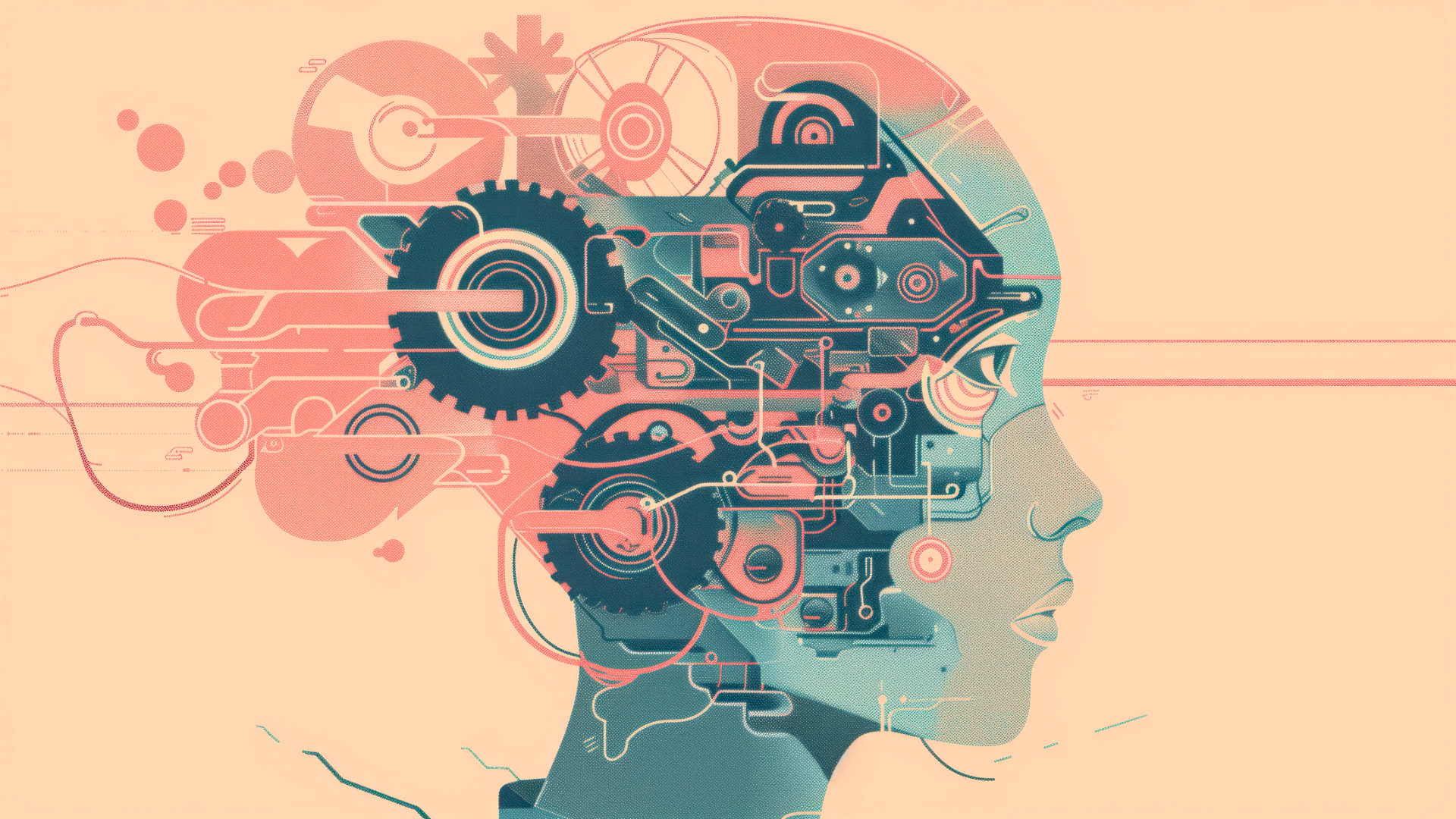
Artificial intelligence AD 2026 resembles a brilliant polymath who defends his PhD in quantum physics on Monday only to fail a shoelace tying test on Tuesday. According to Stanford University’s latest Artificial Index Report 2026, we have reached a point where algorithms have not only caught up, but overtaken human experts in science and multimodal reasoning. This is no longer evolution; it is a digital blitzkrieg, with the industrial sector producing more than 90 per cent of the leading models and four out of five people at universities treating AI like a third hemisphere brain.
However, this brilliant picture has a crack in it, which researchers call the ‘jagged frontier’ (jagged frontier). It is a fascinating paradox: a model that solves Olympic mathematics tasks without flinching capitulates before the … the dial of an analogue watch. The example of the Gemini Deep Think, which only reads the time correctly 50.1% of the time, is as comical as it is sobering.
We are used to thinking of progress as a rising, smooth line. The Stanford report brutally verifies this belief. It shows a technology with almost godlike analytical capabilities, which at the same time stumbles over thresholds that a kindergartner passes effortlessly. This means that we are implementing systems that are at once superhumanly clever and painfully naive. The core competency in IT is no longer ‘implementing AI’ per se, but precisely mapping those invisible cliffs where the machine’s logic ends and its digital myopia begins.
Peaks of possibility: When an algorithm puts a scientist to shame
When you look at the hard data from the SWE Bench-Verified test, you get the impression that developers should slowly consider changing their profession to goose farming. A score jumping from 60% to 100% in just twelve months is a complete takeover of the sandbox where humans ruled until recently. AI is now reaching doctoral level in the sciences and crushing the mathematical competition, becoming the analytical partner we have been dreaming of for decades.
The problem arises, however, when that same digital titan has to look at the wall. Literally. The aforementioned case of Gemini Deep Think and its 50.1 per cent efficiency in reading an analogue clock is a manifestation of the jagged frontier – a phenomenon in which the limit of an algorithm’s capabilities is not a continuous line, but a jagged boundary. The machine reasoning is multi-modal, operating on abstractions we don’t grasp, while stumbling over simple perceptual mechanisms we have mastered at the age of six.
The same is true of AI agents. Their effectiveness in operational tasks in the OSWorld environment has increased spectacularly – from a niche 12% to an impressive 66%. This sounds like a success, until you realise that in business practice this means an error in one in three attempts. In the structured world of corporate systems, a margin of error of 33% is not ‘progress’, but a massive operational risk.
This erraticity makes AI like a brilliant pianist who can play the most difficult Liszt sonata, but doesn’t always hit the keys when he is supposed to perform ‘There’s a kitten on a hurdle’. It is this unpredictability, not a lack of computing power, that is the biggest challenge for IT system architects today. We need to learn how to manage technology that is both omniscient and …. disarmingly inattentive.
The wall you can’t see: Gemini and the unfortunate watch
The implementation of artificial intelligence in organisations has reached a staggering 88% in 2026. In the business world, this is a result that is close to a plebiscite for breathing room – almost everyone is doing it, because no one wants to stay in a digital stasis. However, this massive flight to the front is taking place to the accompaniment of a worrying grinding of the brakes, or rather a chronic lack of them. The Stanford report sounds the alarm: responsible AI is not advancing at the same pace as its raw capabilities.
In the last year, the number of documented AI incidents has risen to 362, up from 233 the year before, which should give policymakers pause for thought. These are no longer theoretical mistakes in sterile labs, but real stumbling blocks at the interface between technology and market. To make matters worse, engineers are facing an innovative paragraph 22: safety versus precision. Research shows that attempts to ‘tame’ models and put ethical muzzles on them often result in a decline in their effectiveness. We want AI to be safe, but when it becomes too cautious, it stops delivering the brilliant results we hired it for.
It’s a classic technology stalemate. Almost all the makers of top models are keen to brag about their performance records, but when it comes to reporting on liability tests, there is suddenly a significant silence in the industry. The IT sector is speeding towards the horizon in a car with seatbelts still in the conceptual stage.
Business on the brink: 88% adoption and no brakes
The geopolitical chessboard of AI in 2026 resembles a game in which the incumbent grandmaster, the US, is starting to glance nervously at the clock – and not just because Gemini is having trouble reading it. Although US dollars are still flowing in a broad stream, the technological advantage over China has almost completely melted away. Worse still, the most valuable ammunition in this race – human genius – is beginning to evaporate from Silicon Valley.
The dramatic 89 per cent drop in the number of AI researchers moving to the US since 2017 (with as much as 80 per cent of this occurring in the last year!) is a painful side-effect of migration policy and the rising cost of H-1B visas. While the US is betting on massive data centres, China is taking the lead in patents, industrial robotics and the number of scientific publications. New dots are also shining on the innovation map: South Korea dominates in patent density, and Singapore and the United Arab Emirates are becoming the training grounds for the world’s fastest technology adoption, leaving the giants behind.
The open source movement, which effectively democratises access to AI, and the issue of public trust play a key role in this new split. There is a gigantic gap here: 73% of experts see AI as having a bright future, but only 23% of the public share this enthusiasm. Those regions that can tame this fear will win. The European model of regulation, although often criticised for being slow, builds a foundation of trust that is dramatically lacking in the US – with record low levels of faith in government.
The conclusion? Success in AI is no longer just about having the most powerful model, but about navigating the geopolitical and human fabric in which that model operates. AI is a new form of national sovereignty – and one that is not built on silicon alone, but above all on open doors for talent and wise, trustworthy law.