Every one of us has seen it in the grocery shop. Your favourite chocolate bar, which used to weigh 100 grams, suddenly weighs 90, even though the price on the shelf has not budged. However, the phenomenon of shrinkflation – i.e. a hidden increase in price by making a product smaller – is no longer the domain of the FMCG market alone. Everything seems to indicate that the coming spring will bring us a technological version of this trend. This time, however, it will not be sweets that are being slimmed down, but the configurations of our laptops and workstations.
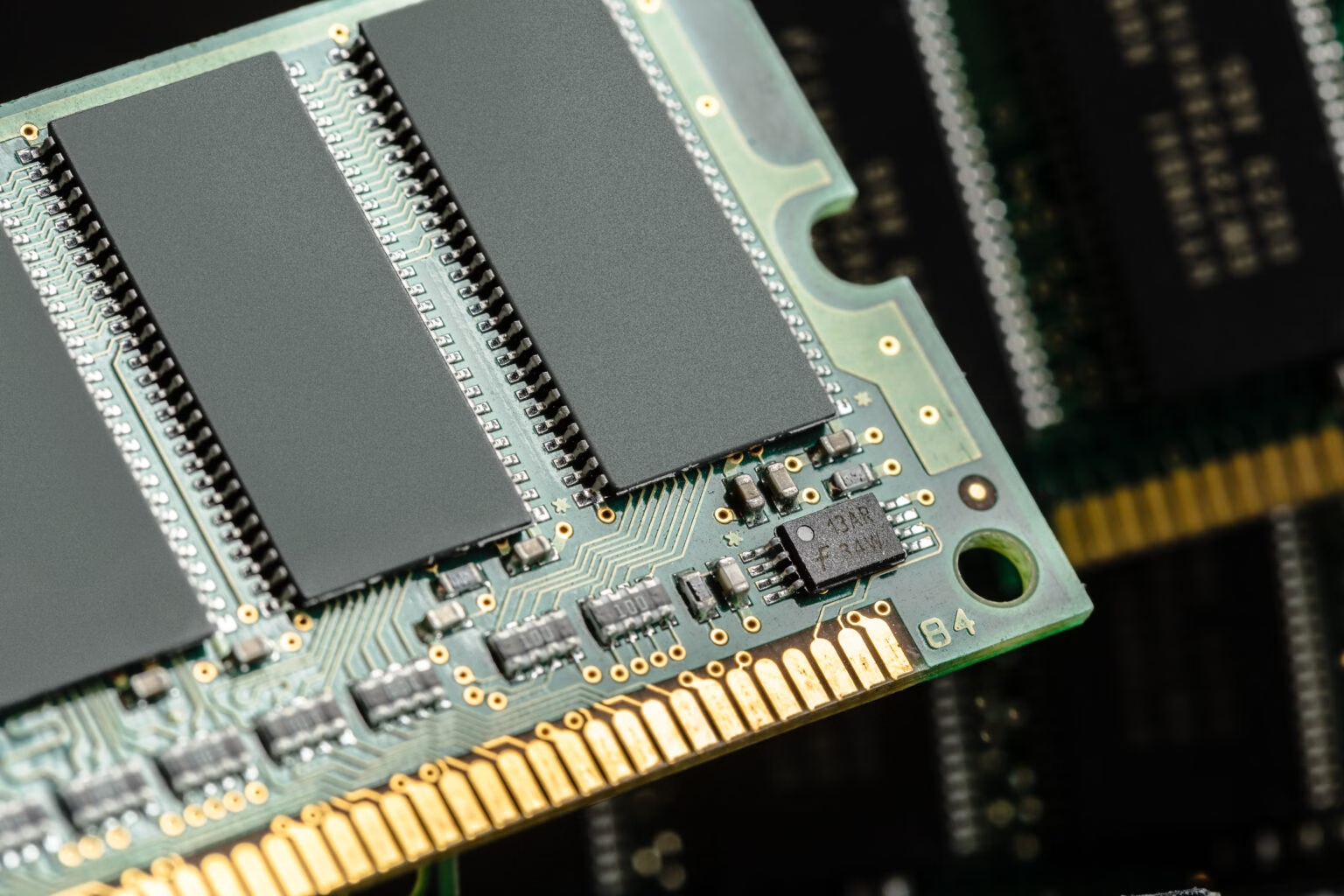
Over the years, the IT industry has accustomed us to a comfortable trend: each successive generation of hardware has offered more computing power and memory for the same (or less) money. Moore’s Law and economies of scale worked in favour of the end customer. This mechanism is just now coming to a halt. The reason is the rapid turbulence in the RAM market, where prices for DDR5 modules have shot up by 100 and, in extreme cases, even 200 per cent in recent weeks. This is an upheaval that cannot be swept under the carpet, and its effects will be felt sooner than we think.
The era of safe stocks is over
Until now, the PC market has been somewhat impregnated against these increases. The big players, such as HP, had massive stockpiles that acted as a safety buffer, cushioning spikes in component prices from suppliers. As a result, distributors’ price lists remained relatively stable, even though the component exchanges were at fever pitch.
However, this protective period is coming to an end. Enrique Lores, CEO of HP, leaves no illusions in his market forecasts. He is signalling clearly that the giant’s accumulated stocks are likely to run out by next spring. This is a key moment for the entire sales channel. When the warehouses empty, manufacturers will have to go out into the market and buy components at new, drastically higher rates.
For the reseller and integrator, this means one thing: current pricing is a relic of the past that will only last for another quarter, maybe two. Then there will be a painful collision with the new BOM (Bill of Materials) cost.
Less RAM or a higher invoice
This brings us to the crux of the problem, namely the aforementioned shrinkflation. Hardware manufacturers are well aware that the market – especially in the entry-level and SME segments – is extremely price-sensitive. Raising the price of an entry-level office laptop by 15-20% can drastically suppress demand.
What strategy will the industry adopt? According to predictions coming from the HP camp, in order to maintain certain price points, manufacturers will be forced to cut specifications. In practice, this could mean that a model that was offered with 16 GB of RAM as standard this year will only have 8 GB on board at the same price next year.
Devices with a ‘decent’ amount of memory will not disappear, but will inevitably move into the premium category. The customer will have a choice: accept inferior performance on an old budget or dig deeper into their pockets.
While in the case of powerful workstations for engineers or graphic designers, companies are likely to ‘swallow this sour apple’ – because there performance is business-critical – in the case of bulk orders for offices or schools, we can expect a return to configurations that until recently we considered the bare minimum, not to say relic.
Why is it so expensive? The invisible AI tax
One might ask: why is memory getting more expensive just now, when the PC market is still licking its wounds after the post-pandemic slowdown? The short answer is Artificial Intelligence.
The PC industry has become somewhat hostage to the AI revolution. Memory manufacturers such as Micron and Samsung are acting rationally. Seeing the tech giants’ insatiable appetite for servers to train language models, they are redirecting their production capacity to the manufacture of HBM (High Bandwidth Memory). It is these dice that are essential to the operation of AI accelerators and it is these that are currently generating the highest margins.
The problem is that a semiconductor factory is not a bakery – you cannot change the product range or add a new production line overnight. New factories take years to build and cost billions of dollars. So, since the production lines are busy producing expensive memory for AI servers, there is not enough room to produce ‘ordinary’ RAM for laptops.
We are dealing with a classic domino effect. DDR4 production has been largely extinguished (which has already driven up its prices), and DDR5 supply is not keeping up with demand, as HBM takes priority. As a result, when we buy an ordinary laptop for Excel, we pay a kind of ‘tax’ that funds the construction of Meta or Google data centres, powered by thousands of Nvidia Blackwell processors.
The market abhors a vacuum and the economic calculus is inexorable. In 2026, AI will not only change the way we work, it will also have a real impact on the hardware we use to do that work. There are many indications that the coming spring in the hardware industry will be extremely expensive.