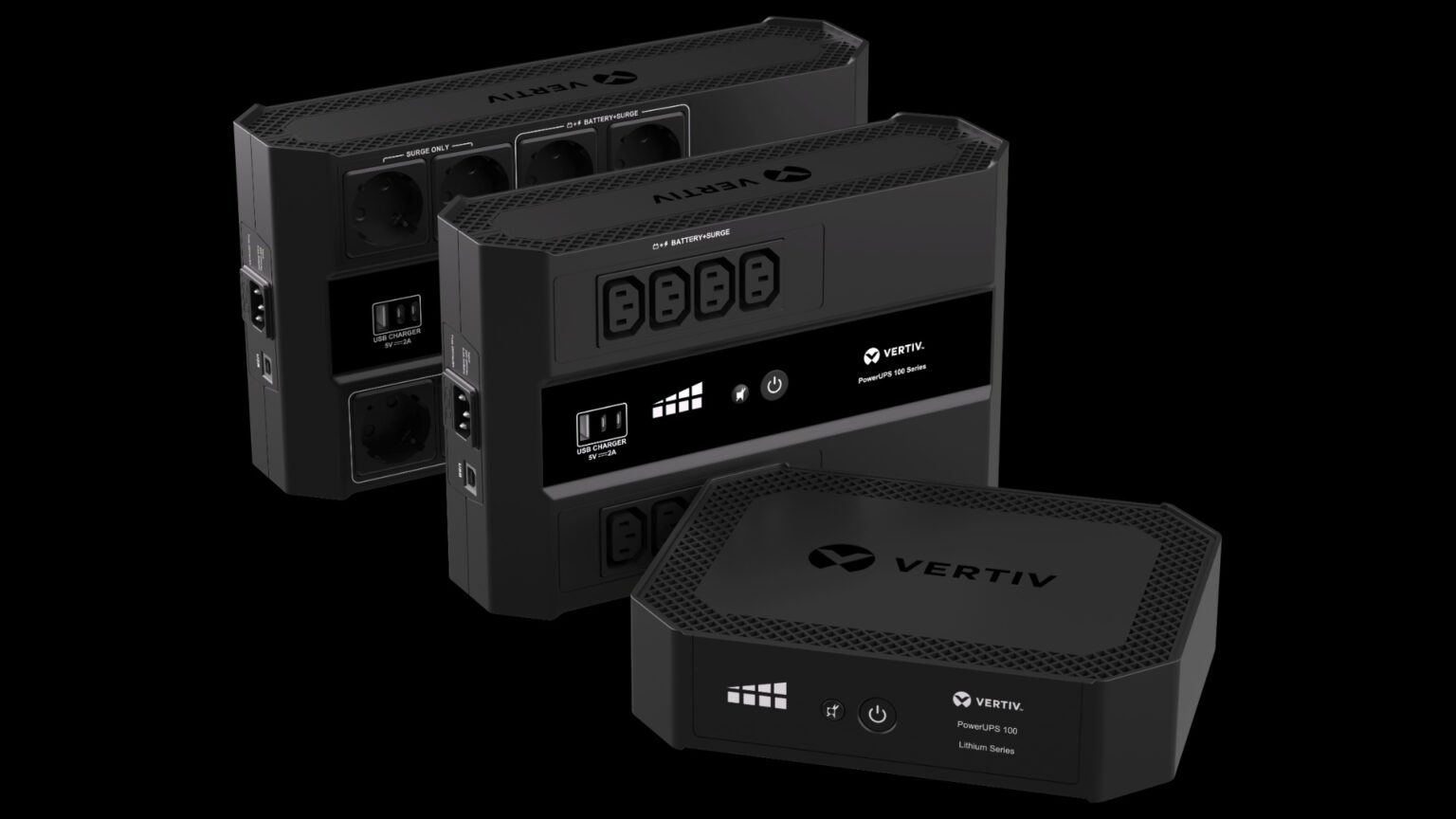
Vertiv is expanding its emergency power supply range with the Vertiv PowerUPS 100 Standby series – compact UPS units designed not for large server rooms, but for workstations, small offices, retail outlets and distributed digital environments. This is a segment that is growing in importance alongside the rise of hybrid working, edge computing, network devices and computers used on-premises to support increasingly critical processes.
The new series is available in the EMEA region in 230 V versions. It comprises models with VRLA batteries ranging from 500 to 900 VA, as well as a 350 VA lithium-ion variant. In practice, this means that Vertiv is targeting users who do not require a complex power infrastructure but wish to minimise the risk of data loss, downtime or equipment damage following a brief power cut.
The units feature up to eight sockets with battery backup and surge protection. They are also equipped with USB-A and USB-C ports for charging mobile devices. The compact housing and wall-mounting option indicate that the product was designed with spaces where room is limited in mind, such as shop back rooms, home offices, small service outlets or points of sale with payment terminals.
Product lifecycle management is also a key consideration. The batteries can be replaced by the user, which can reduce maintenance costs and extend the equipment’s service life. VRLA models come with a three-year warranty, whilst the lithium-ion version comes with a five-year warranty. The lithium-ion design is also said to offer a longer service life and faster charging than traditional lead-acid solutions.
The launch of the PowerUPS 100 Standby demonstrates that the uninterruptible power supply market is moving beyond the traditional data centre. An increasing number of business processes are operating at the network edge, at the user’s workstation or in small remote locations. In such conditions, even a small UPS ceases to be merely an accessory and becomes a straightforward tool for business continuity. For Vertiv, this also marks the completion of the refresh of its range of single-phase UPS units for the end points of IT infrastructure.