
The growth of digital printing, the increasing number of short-run and varied print runs, and the need to maintain high quality mean that print shops are increasingly investing in the automation of production and business processes. This is also confirmed by market data. According to the report *The Future of Global Printing to 2030*, the global printing market was worth approximately USD 868 billion in 2025 and is set to grow to USD 969.7 billion by 2030. This represents an average annual growth rate of 2.2 per cent, driven primarily by the packaging, labelling and digital printing segments.
Why are companies investing in automation?
Just a few years ago, many processes required constant supervision by operators and manual checks at each stage of production. Today, companies are seeking solutions that enable them to automatically monitor workflows, analyse data and respond to deviations before they affect product quality or delivery times.
The benefits of automation extend far beyond technological modernisation. Companies are implementing it to reduce operating costs, shorten order fulfilment times, boost team productivity and scale their operations more effectively. As a result, automation is becoming one of the key tools for building a competitive advantage.
“Just a few years ago, many decisions in a print shop were based primarily on operators’ experience. Today, data has become one of the most important production resources. The ability to monitor equipment performance in real time allows for a faster response to changes and helps maintain process stability even with highly varied production,” says Michał Młynarczyk, a production printing expert at Canon Poland.
Automation at the production level
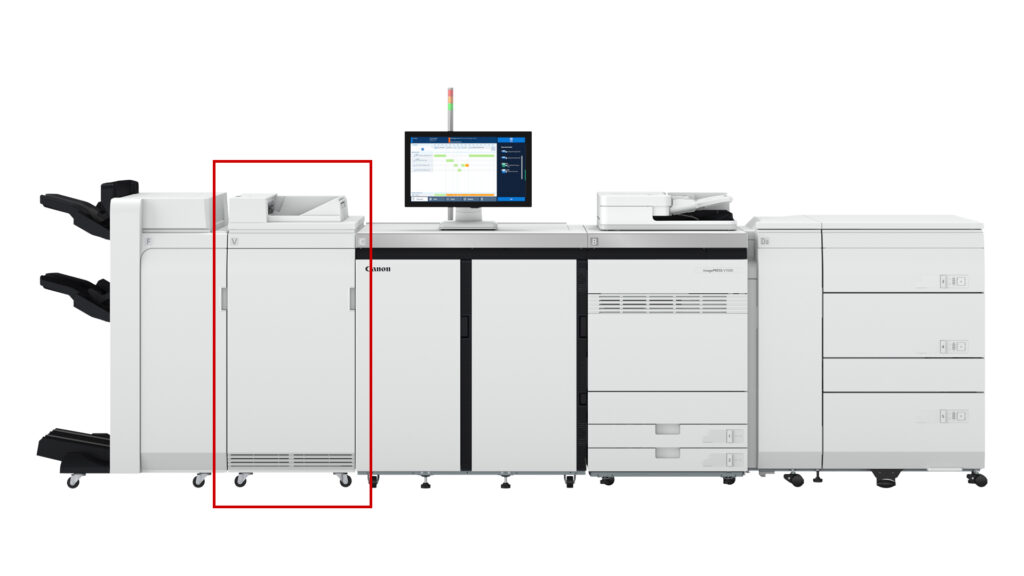
An example of automation being used directly in the production process is the Sensing Unit available for Canon imagePRESS V-series devices – the imagePRESS V1350, imagePRESS V1000 and imagePRESS V900.
During production, the solution monitors, amongst other things, colour stability, front-to-back registration, image positioning and toner transfer parameters. If any deviations are detected, the system automatically applies corrections whilst printing is still in progress, helping to maintain high quality without the need for manual intervention by the operator.
Thanks to real-time data analysis, the print shop can respond as things happen, rather than only identifying a problem once the print job is complete. This means fewer test prints, less waste and greater predictability in production processes.
“One of the greatest challenges facing modern print shops is maintaining consistent quality whilst dealing with an ever-increasing number of short-run and varied jobs. The Self-Regulation module allows some control processes to be shifted from manual operation to automatic monitoring and adjustment of the machine’s operating parameters. This enables the operator to focus on managing production rather than constantly adjusting settings,” says Michał Młynarczyk.
Process digitalisation encompasses the entire business
However, the greatest benefits arise when smart solutions go beyond individual machines to encompass entire business processes.
One example is the implementation carried out by Canon at A3 Producent Flag in Gliwice. The company has implemented an integrated system supporting the process from order receipt, through file and production management, right through to logistics and financial settlements. Thanks to data centralisation and process integration, the flow of information between departments has been streamlined, control over order fulfilment has been enhanced, and the risk of operational errors has been reduced. The company has also gained a stronger foundation for further development and scaling of its operations.
The system supports, amongst other things, automatic order validation, production planning, stock monitoring, order fulfilment, dispatch preparation and financial processes. This approach allows for more effective management of the growing number of orders without a proportional increase in workload.
A smart factory is a competitive advantage
Examples of the Self-Regulation Module and its implementation at A3 Producent Flag demonstrate that modern technologies can support not only the production process itself, but also the management of orders, logistics and data flow within an organisation.
A modern smart factory is not a single device or system, but a combination of automation, data and integrated processes. In a world of rising customer expectations and increasingly complex production processes, it is precisely the skilful use of these elements that is becoming one of the key factors in building a competitive advantage.