In the second half of 2026, the number of AI pilot projects launched will no longer be the deciding factor. What will matter is the ability to select the few processes of greatest significance, redesign them from start to finish, and swiftly discontinue initiatives that do not generate value.
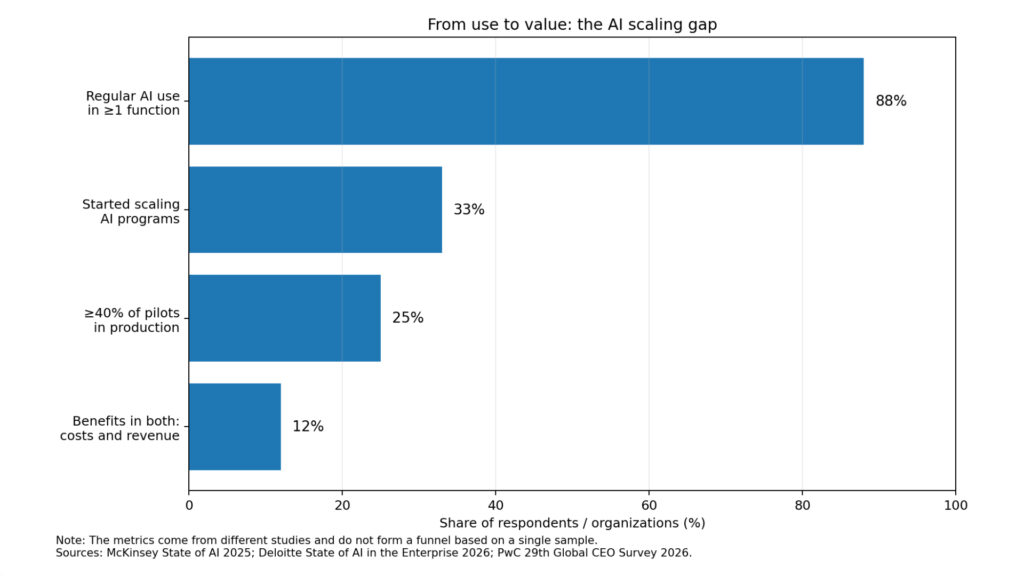
AI has become the most important area of technological investment: half of all companies cite it as a priority for the next two years. At the same time, there remains a significant gap between adoption and financial results. According to McKinsey, 88 per cent of organisations regularly use AI in at least one function, but only around a third have begun to scale up their programmes. Deloitte reports that a mere 25 per cent of organisations have taken at least 40 per cent of their pilot projects into production. In a PwC survey, 56 per cent of CEOs reported neither an increase in revenue nor a reduction in costs, whilst only 12 per cent achieved both outcomes simultaneously.
What is the situation?
The problem for businesses is no longer a lack of ideas for using AI. The problem is an excess of isolated initiatives: an assistant for one team, a chatbot on a single channel, an experiment with code generation, or local document automation. Each project may work correctly, but together they do not form a new operational model.
The best-performing organisations do not limit themselves to simply applying AI to existing tasks. 55 per cent of companies achieving the best results with AI report a fundamental overhaul of their processes, compared with 20 per cent of the rest. These companies are more likely to combine efficiency targets with growth and innovation, rather than treating AI solely as a cost-cutting programme.
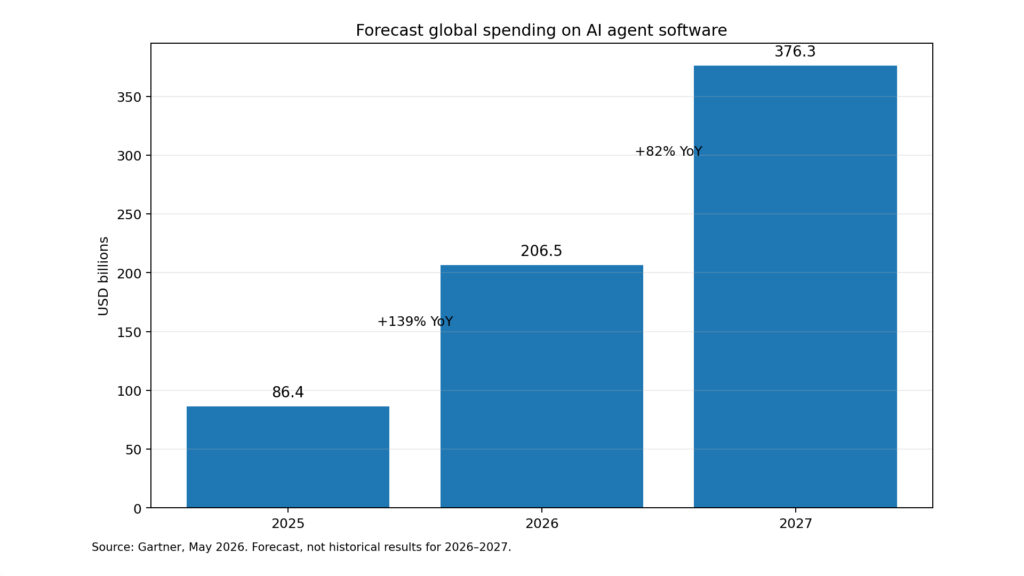
The second factor is the rapid development of AI agents. Currently, around 17 per cent of organisations have implemented them, but over 60 per cent plan to do so within two years. Gartner forecasts that global spending on AI agent software will rise from US$86.4 billion in 2025 to US$206.5 billion in 2026 and US$376.3 billion in 2027. At the same time, it predicts that by 2027, 40% of enterprises will restrict the autonomy of these agents or completely withdraw some implementations due to gaps in management and control.
The third element is regulation. From 2 August 2026, the main provisions of the EU AI Act will come into force, including rules on transparency, and the Commission will be granted enforcement powers over providers of the most advanced general-purpose models. The deadlines for some high-risk systems have been postponed to 2027–2028, but the obligation to carry out an inventory of systems, assign responsibility and monitor AI-generated content can no longer be put off until ‘later’.
What does this mean for technology companies?
The market is shifting from simply selling access to a model towards providing a complete solution for a specific process. Gartner forecasts that spending on AI platforms and models will rise by 63.4 per cent in 2026, with the specialised generative models segment growing by as much as 210 per cent. Vendors will therefore compete not only on the quality of the model’s responses, but above all on integration, cost predictability, latency, quality assessment, security and the ability to enforce organisational policies.
Another generic ‘copilot’ will be difficult to justify from a business perspective. Products that solve an entire industry-specific problem — such as handling complaints, analysing technical documentation, the procurement process, or software development and testing — will offer greater value, particularly when combined with integration into the client’s systems and measurable operational impact.
What does this mean for the CIO?
The CIO should move from managing a list of use cases to managing an investment portfolio. Each project should have a business owner, a baseline process outcome, a target change, a full cost of ownership, and pre-defined termination criteria.
A practical portfolio for the second half of the year could consist of four categories:
- Scale — solutions in production, with proven adoption and an impact on results or quality.
- Fix — valuable projects that are currently blocked by data, integrations or organisational change.
- Experiment — short, budget-constrained tests of new possibilities, particularly AI agents.
- Close — initiatives lacking a process owner, a baseline, regular users or a realistic business case.
- Shared components — access to models, data, knowledge search, quality monitoring, security, system logs and cost control — should be built centrally. The process implementations themselves may remain federated, close to the business units.
What does this mean for the board?
AI is becoming a capital allocation decision, not merely a technology. The board should not ask how many pilot projects the company has, but rather:
What percentage of the portfolio has gone into production? Which process outcome has changed? How much does a single AI transaction cost? Where does the system make or execute decisions? Who is responsible for the outcome and the risk?
Strong foundations have a measurable link to results. According to PwC, organisations with a mature technological environment and formal Responsible AI policies are three times more likely to report significant financial benefits. Meanwhile, only 51 per cent of companies have formalised their approach to AI risk.
Controls should be proportionate to the system’s autonomy. A tool that merely reads documents does not require the same safeguards as an agent capable of modifying data, sending communications or initiating transactions. A one-size-fits-all approach for all agents leads either to the blocking of simple applications or to insufficient control over high-risk systems.
Plan for the second half of 2026
By the end of the year, the organisation should take three steps.
Firstly, review all AI initiatives and make clear-cut decisions: scale up, fix, continue experimenting or shut down.
Secondly, select between three and five key processes where AI can transform the entire workflow, rather than merely speeding up a single task. Success should be measured by the outcome of the process: turnaround time, quality, conversion, retention, margin or risk reduction.
Thirdly, introduce a quarterly review of the AI portfolio at board level, combining value, cost, adoption and risk. The budget should be channelled towards projects that deliver results, rather than remaining allocated to initiatives simply because they were launched earlier.
What will happen next?
The most likely outcome will be a reduction in the number of independent pilot projects and a concentration of investment around a few platforms and processes of the greatest significance. AI agents will become increasingly common, but in many applications they will remain under human supervision. Managing models, their costs, quality and permissions will become a permanent feature of enterprise architecture.
As a result, the companies that gain the upper hand will be those that are quickest to transform an experiment into a repeatable business outcome — and just as quick to abandon projects that fail to deliver that outcome.
An AI strategy for the second half of 2026 should therefore not ask ‘what else can we test?’, but rather ‘which processes do we want to overhaul, and which initiatives are we prepared to discontinue?’.