The claim that there are “fewer large-scale implementations” cannot be easily corroborated by official statistics, as the Central Statistical Office (GUS) does not distinguish between new installations and the migration or expansion of existing systems. However, the market structure leaves little room for doubt. In 2025, 40.5 per cent of Polish businesses were using ERP systems, 4.5 percentage points more than in 2023. Across the EU as a whole, 89 per cent of large companies already had systems of this type. In the mature corporate segment, therefore, the question is increasingly less about ‘whether to implement an ERP system’and more about what to remove, what to standardise, and how to ensure business continuity during the overhaul.
This shift reflects the broader logic of investment in Polish companies. In 2025 , expenditure by companies employing at least 50 people rose by 3.2 per cent in real terms, but the number of new investment projects fell by 2.2 per cent. At the same time, the modernisation of existing fixed assets already accounted for 52.5 per cent of the value of new projects, compared with 43.2 per cent the previous year. These figures do not relate exclusively to IT, but accurately describe how money is being spent: fewer projects, higher value and a focus on improving what is already in place.
In the first quarter of 2026, business investment rose by 8.7 per cent. However, companies continued to cite high implementation costs, an uncertain macroeconomic situation and unstable regulations as the main barriers. This situation favours phased projects with limited risk and a short timeframe to the first measurable result. A multi-year programme to replace the entire IT infrastructure is becoming increasingly difficult to justify to the board compared to a specific overhaul of finance, production or logistics.
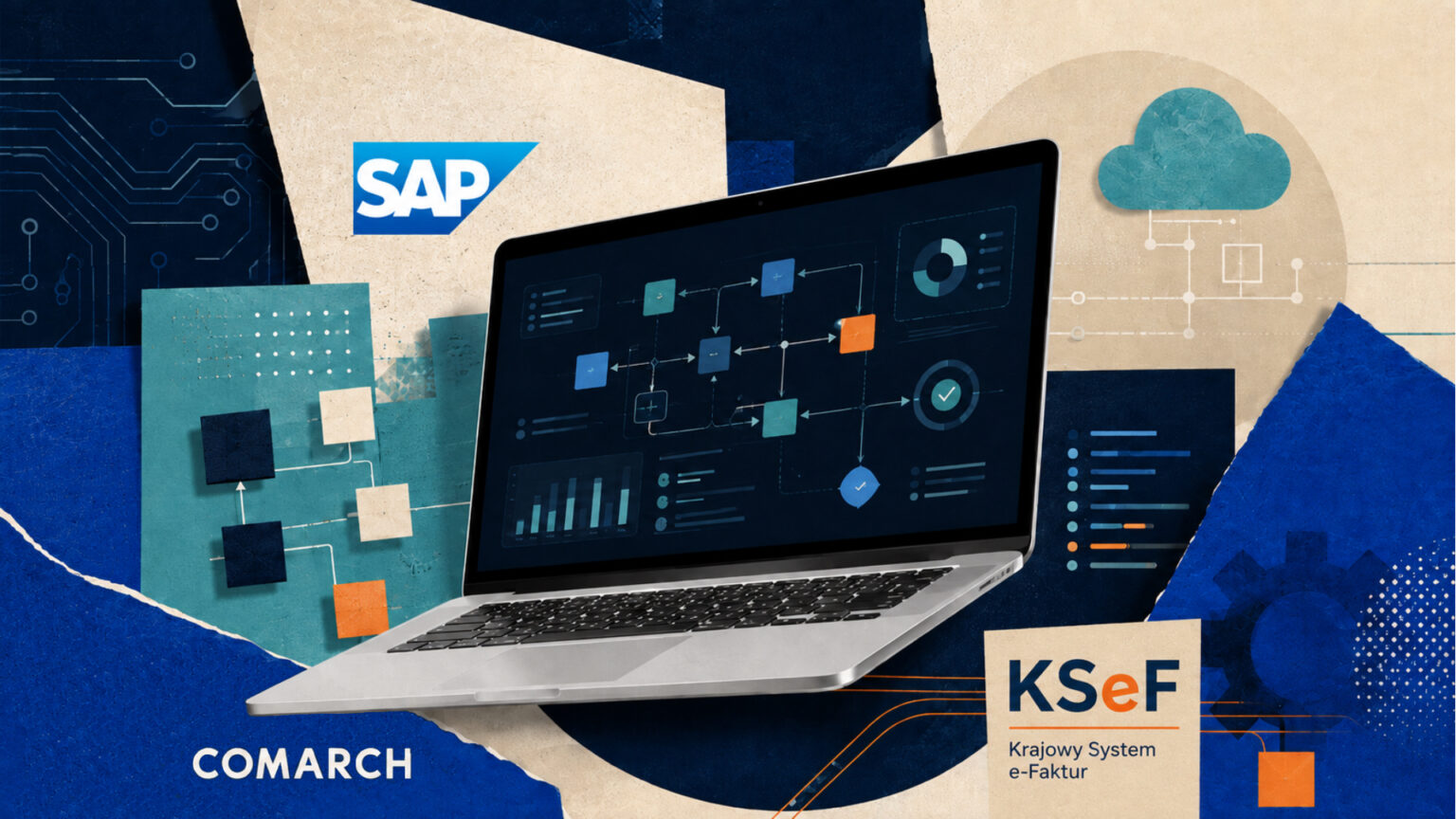
The strongest catalyst for ERP modernisation today is not artificial intelligence, but regulation. KSeF 2.0 has been in force since 1 February 2026. From 1 April, the obligation essentially extended to all other businesses, whilst the smallest entities with monthly invoiced sales of up to 10,000 PLN will join the system on 1 January 2027.
KSeF is not simply a matter of sending a document in a new format. It changes the flow of invoices, user permissions, corrections, the handling of exceptions and the method of accounting. A simple add-on may ensure technical compliance, but it will not resolve discrepancies in customer records, manual approvals or processes that end up in a spreadsheet. The regulation therefore exposes a legacy debt that has remained hidden for years beneath successive system integrations and modifications.
The second clock is ticking for SAP. Standard support for the core Business Suite 7 applications ends in 2027. Extended maintenance will be available until the end of 2030 and will increase the service fee by two percentage points. For some of Poland’s largest companies, migration is no longer a strategic decision but a matter of technological risk management. However, this does not necessarily mean a ‘big bang’ approach. Rather, the pressure of deadlines increases the importance of conversion, removing unnecessary extensions and breaking the transformation down into stages.
Velvet CARE illustrates this well. The manufacturer did not build the environment from scratch, but carried out a conversion to SAP S/4HANA. The project lasted six months, 99 per cent of which was carried out remotely, and the final system downtime amounted to two days. Production was not halted, despite the need to check nearly a thousand operations. This is the key difference between modernisation and a traditional implementation: the aim was not to make a symbolic clean break with the past, but to minimise operational risk.
Amica opted for a larger scale but a similar approach. The migration from one of Poland’s oldest SAP ECC systems was divided into two phases, covering successive group companies. The project aims to retain the valuable elements of the existing solution, whilst simultaneously restructuring production and integrating planning, scheduling and the MES system. This is still a major transformation, but its core is not the purchase of a new ERP system. Rather, it is the unification of processes within a group operating in nearly 70 markets.
The case of Termomodernizacje shows that ERP modernisation does not necessarily have to be a multi-year programme. The company, operating in the construction and renewable energy sectors, replaced two incompatible systems with Comarch ERP Optima, integrating finance, sales, and HR and payroll. The implementation, including data migration and organisation, took one and a half months. According to a case study published by Comarch, the time taken for bookkeeping was reduced by 15 per cent, whilst the import of bank statements and the processing of payments were accelerated by 20 per cent. More important than the automation itself was the ability to calculate the profitability of individual contracts and stages on an ongoing basis, and to monitor subsidies and client funds. This is an example of a limited-scale modernisation, but one with results directly visible in the project’s accounts.
New implementations have not disappeared. Polish Nuclear Power Plants launched SAP S/4HANA and SuccessFactors in the public cloud in less than eight months, utilising ready-made process models. Today, large-scale projects naturally find their place primarily in new organisations, consolidated groups and strategic investments built without years of accumulated technological debt.
The ERP market is not slowing down. It is changing what it sells. The licence and system go-live are no longer the main focus. Budgets are shifting towards data quality, integrations, security, test automation and standardisation of work across companies. A project that amounts to nothing more than a version upgrade is simply costly maintenance. Modernisation only begins to create value when it eliminates unnecessary exceptions, shortens information flows and allows a process to be completed without another sheet of paper being sent by post.