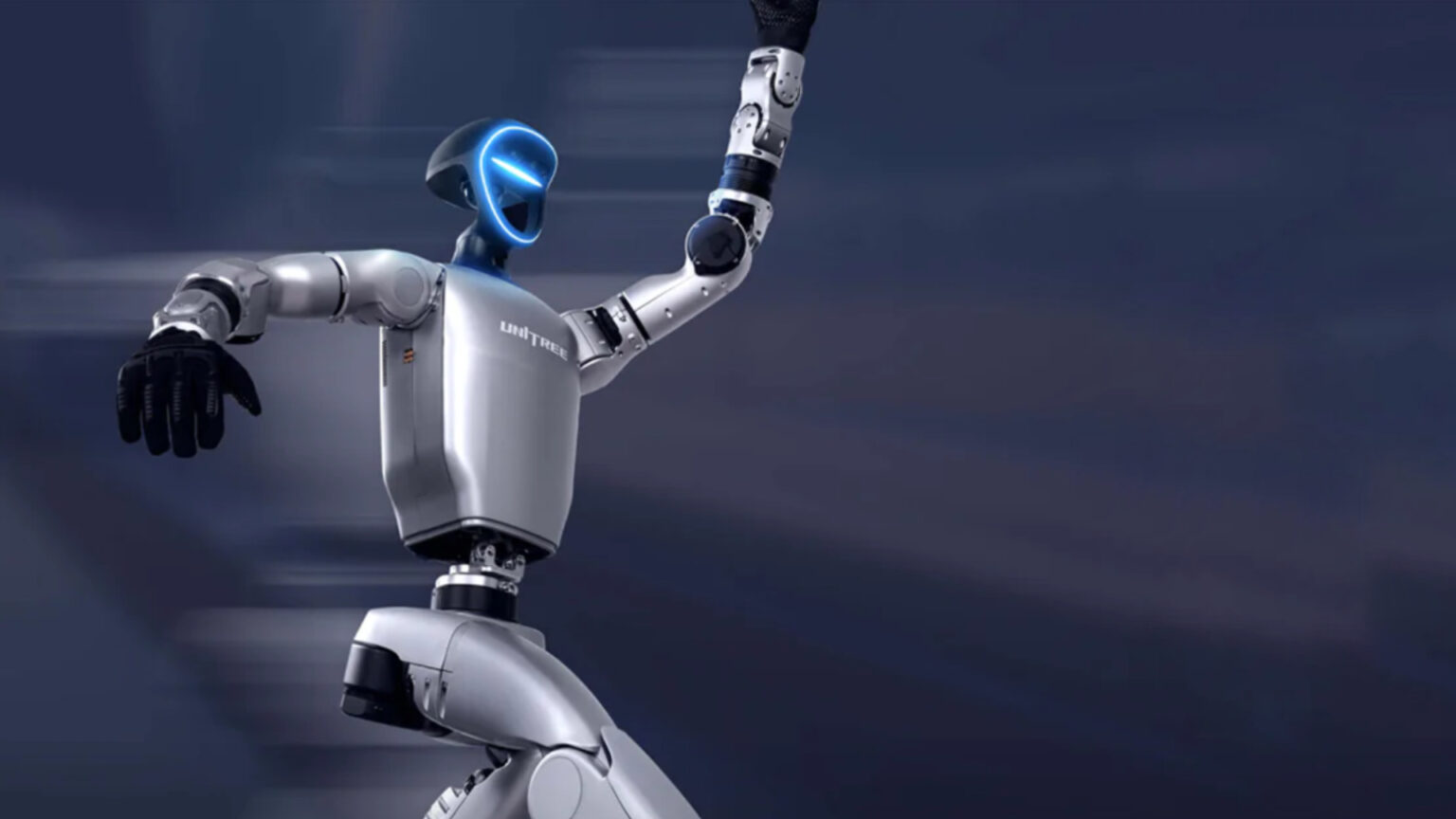
Chinese robot manufacturer Unitree has recorded one of the most spectacular stock market debuts of the year. On 19 August, the company’s shares on the STAR Market in Shanghai rose by 629 per cent at the opening compared to the issue price of 150.8 yuan, and closed the day at 845 yuan, up 460 per cent. The company raised approximately 6.1 billion yuan from the IPO.
The scale of this rise demonstrates the high expectations investors currently have for so-called ‘embodied AI’, i.e. artificial intelligence operating within physical machines. Unitree is also attracting attention due to the capabilities of its designs. According to the company, its latest humanoid model, Superman, can run at a speed of 12.66 m/s and jump two metres high.
However, real revenue is beginning to emerge alongside these technological demonstrations. In 2025, Unitree achieved 1.7 billion yuan in sales, over 40 per cent of which came from overseas. At the same time, the practical applications of humanoids remain limited, and the industry is only just moving from demonstrations to regular use in factories, logistics and services.
Beijing wants to speed up this process. The Chinese authorities plan to deploy 10,000 humanoid robots by the end of 2026 and develop over 100 valuable application scenarios. Unitree’s success may therefore also make it easier for competitors to raise capital and accelerate investment in production, software and components.
At the same time, robotics is increasingly becoming part of the technological dispute between China and the US. In July, the US FCC restricted the import of new foreign humanoid and quadrupedal robots on safety grounds. This could lead to the gradual emergence of two distinct technological ecosystems. The stock market euphoria surrounding Unitree is therefore both a bet on the rapid growth of a new market and a sign that its expansion will be increasingly shaped by geopolitics and regulation.