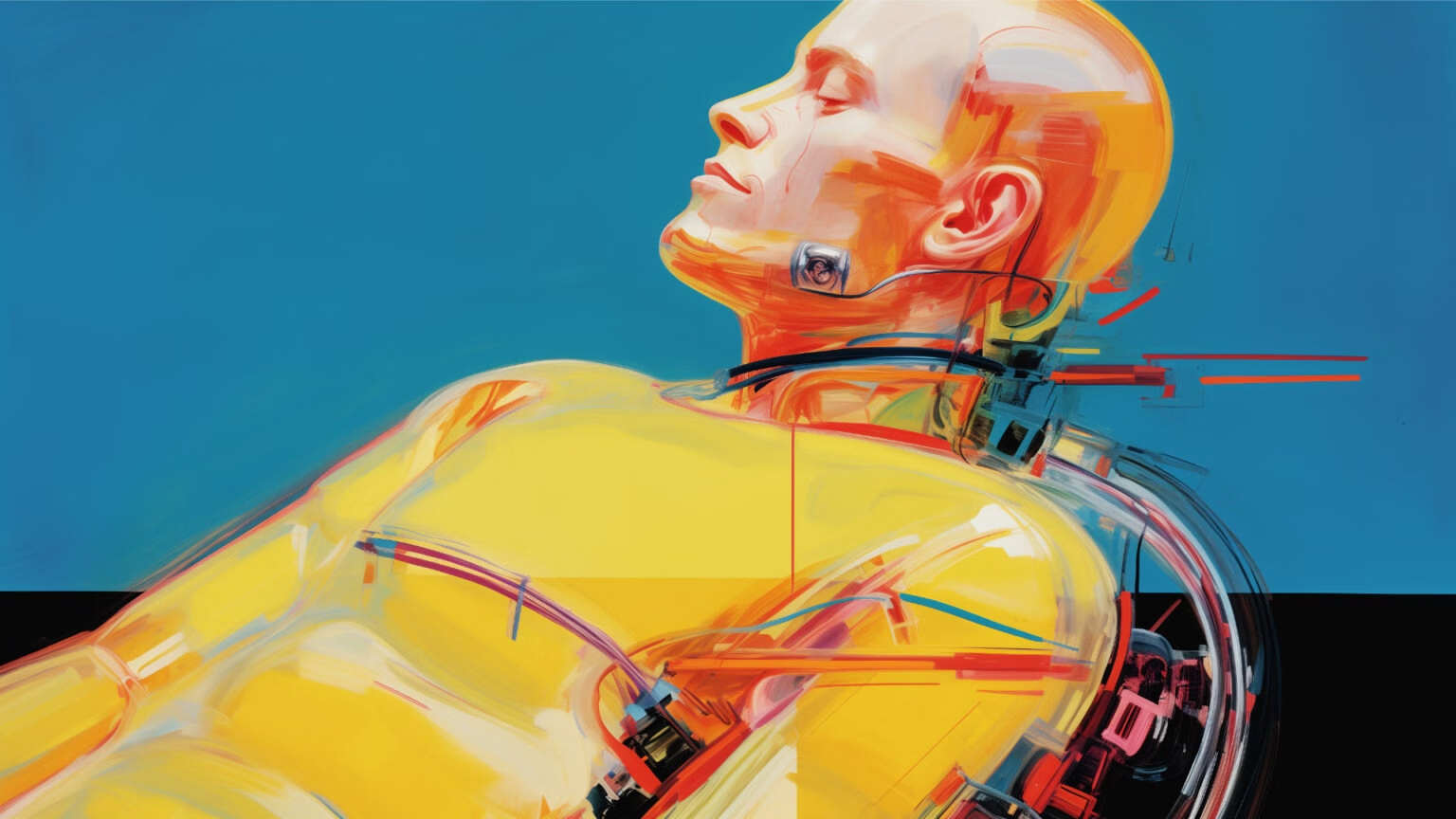
For years, the construction of autonomous machines resembled elite alchemy – it was expensive, complex and accessible only to the few best-funded research centres. Today, however, we are witnessing a tectonic shift. A profound marriage between advanced artificial intelligence andopen source philosophy is taking place before our eyes.
The effect of this fusion can be seen with the naked eye. Machines are beginning to autonomously analyse situations, make decisions and act in the physical world in ways that not long ago were considered a distant song of the future. We are entering a time of unprecedented collaboration between humans and technology, where lines of code written and improved by a global community are driving complex mechanical systems. However, it is worth wondering whether this sudden wave of openness is pure idealism or perhaps a very deliberate, long-term market strategy by technology giants.
Lesson from history: From academic chaos to a universal standard
To get a good understanding of the current revolution, one needs to go back to the mid-1990s. The landscape of robotics at the time resembled a technological Tower of Babel. Every university, company or research team was building their systems completely from scratch. Software was rigidly assigned to a particular model of machine, which horrifically shredded the market. Work on advanced algorithms for movement or orientation in space was constantly at a standstill, as engineers wasted the lion’s share of their time writing basic controllers to communicate with motors or sensors.
The real breakthrough came in 2007 and the debut of the ROS (Robot Operating System) project. Despite the misleading name, ROS is not a classic operating system, but a flexible development environment running on Linux.
It provided the industry with what it needed most: a universal communication platform. ROS took on all the tedious burden of transferring data between components, mapping the environment, planning routes and integrating with a variety of hardware.
The pioneers of this project, many of whom today develop technology within Alphabet’s structures, saw the analogy between robotics and the early internet from the start. Since the global web was so staggeringly successful precisely because of its openness and shared tools, the same mechanism must have worked in the world of machines. Soon after, artificial intelligence developers followed an identical path, sharing models and databases. Today, these two trends have finally merged into one strong trend.
The new architects of autonomy: the strategy of the big players
However, modern open source robotics is no longer the domain of enthusiasts and researchers alone. Corporations with huge capital have entered the game and have seen in open code the ideal tool to build market dominance.
The NVIDIA ecosystem as a new platform for the masses
NVIDIA, usually associated with processor manufacturing, is very cleverly redefining the way we teach machines to interact with the environment. Their open platform covers the entire robot development process:
- Cosmos: Advanced physical models that generate artificial training data and create perfect digital copies of the real world.
- GR00T: Base models that give machines the ability to think logically and perform complex series of tasks.
- Isaac: Coordinating tools that combine the training of algorithms with their testing in simulation and final implementation on a physical device.
Thanks to the massive leap in image recognition systems, the barrier to entry into this industry has virtually ceased to exist. Something that used to require a staff of experts can now be run with a few simple commands. Simulators have become so accurate that the knowledge gained by an algorithm in the virtual world translates seamlessly into its behaviour in the real world. Today, the entry threshold has collapsed so low that you no longer need a PhD in engineering to create advanced systems. Robotics has ceased to be a niche discipline and has become a universal platform for any developer.
Hugging Face and the explosion of the knowledge base
The place where the heart of this new community beats has become the Hugging Face platform. In 2024, it launched the LeRobot sub-project, a dedicated space for artificial intelligence in robotics.
The scale of this phenomenon is best illustrated by hard data. In the short time since the launch of LeRobot, the number of robotic datasets available there has grown from just over a thousand to more than 58,000, becoming the fastest-growing section on the entire platform.
Interestingly, Hugging Face quickly realised that code alone in the physical world was not enough. The acquisition of Pollen Robotics showed that software must go hand in hand with hardware, and the move was aimed at allowing absolutely everyone – from prestigious labs to amateurs tinkering in garages after hours – to build machines.
China’s move on the chessboard
However, the West does not have a monopoly on innovation. Chinese giant Alibaba has thrown down the gauntlet to the competition by launching RynnBrain, an open model for physical artificial intelligence that goes head to head with solutions from Google or NVIDIA in many performance tests.
This diversity is fundamental to business. Modern robotics is no longer based on a single, closed system, but on thousands of tiny, publicly available components that anyone can freely modify and assemble like building blocks.
The double bottom of open code: Business intentions and engineering pitfalls
However, the rapid triumph of open source solutions in this industry requires a cool, analytical assessment. For under the guise of widespread availability lie both market tensions and specific technical problems.
Fear of a digital monopoly in one’s own home
As artificial intelligence systems gain control over the physical bodies of robots, there is a legitimate concern about privacy and security. The vision in which the autonomous machines that help us in our daily lives would be controlled by closed, unintelligent systems owned by just a few Silicon Valley CEOs is pretty bleak.
In this view, the open source movement becomes the only logical alternative. It gives insight into the mechanisms that control devices, provides transparency and allows smaller companies and governments to remain technologically independent.
Free software as an ingenious sales funnel
However, it has to be said openly that today’s open source model is different from the one at the inception of ROS. In the past, technology was shared by disinterested researchers. Today, free code is distributed by corporations that have a very clear financial interest in it.
Why do companies like NVIDIA give away their advanced models without charging? It’s a classic ecosystem-building strategy. By making great, free tools available, they make generations of developers dependent on them.
NVIDIA knows full well that in order to run these models, process gigantic amounts of training data or run simulations smoothly, customers will have to buy their infernally expensive chips anyway. Open code, in this case, is a brilliant marketing tool that moves the competition from the software level to the hardware infrastructure level.
The novice paradox – wasting energy on reinventing the wheel
The low entry threshold, apart from the obvious advantages, has also brought one very specific challenge. Robotics has seen a massive influx of pure artificial intelligence and neural network specialists, who often have no background in classical mechanics or control theory.
This leads to paradoxical situations. A young developer can spend long days on complex training of a neural network just to make a robotic arm move simply from one point to another. Meanwhile, in classical engineering, the same task is solved with a few lines of an elegant mathematical formula, known in robotics since the 1970s. The lack of knowledge of the foundations sometimes causes the industry to waste a lot of time and energy reinventing America.
The landscape after the revolution
Whether the motivation of the tech giants is pure altruism or a desire to monopolise the hardware market, the overall balance of these developments is extremely positive for the market. The engine of innovation in robotics has been permanently unlocked.
The developer community is now larger, more diverse and more dynamic than ever before. Software tools have become intuitive and the barriers separating the world of software and physical machines are slowly disappearing. The future of autonomous devices will not be decided in the privacy of a few secret corporate labs. It is being written on the fly, collaboratively, in public code repositories – and this is where the new balance of power in the global economy is taking shape.