The global economy in 2026 is in a phase of verification of technological enthusiasm. After years of surging interest in generative language models, artificial intelligence has collided with an ‘implementation wall’. The use of AI in companies continues to grow, but the pace of real, deep implementations is much slower than markets and investors expected. The year 2026 will see disappointments due to the lack of immediate return on investment and rising costs and regulatory pressures.
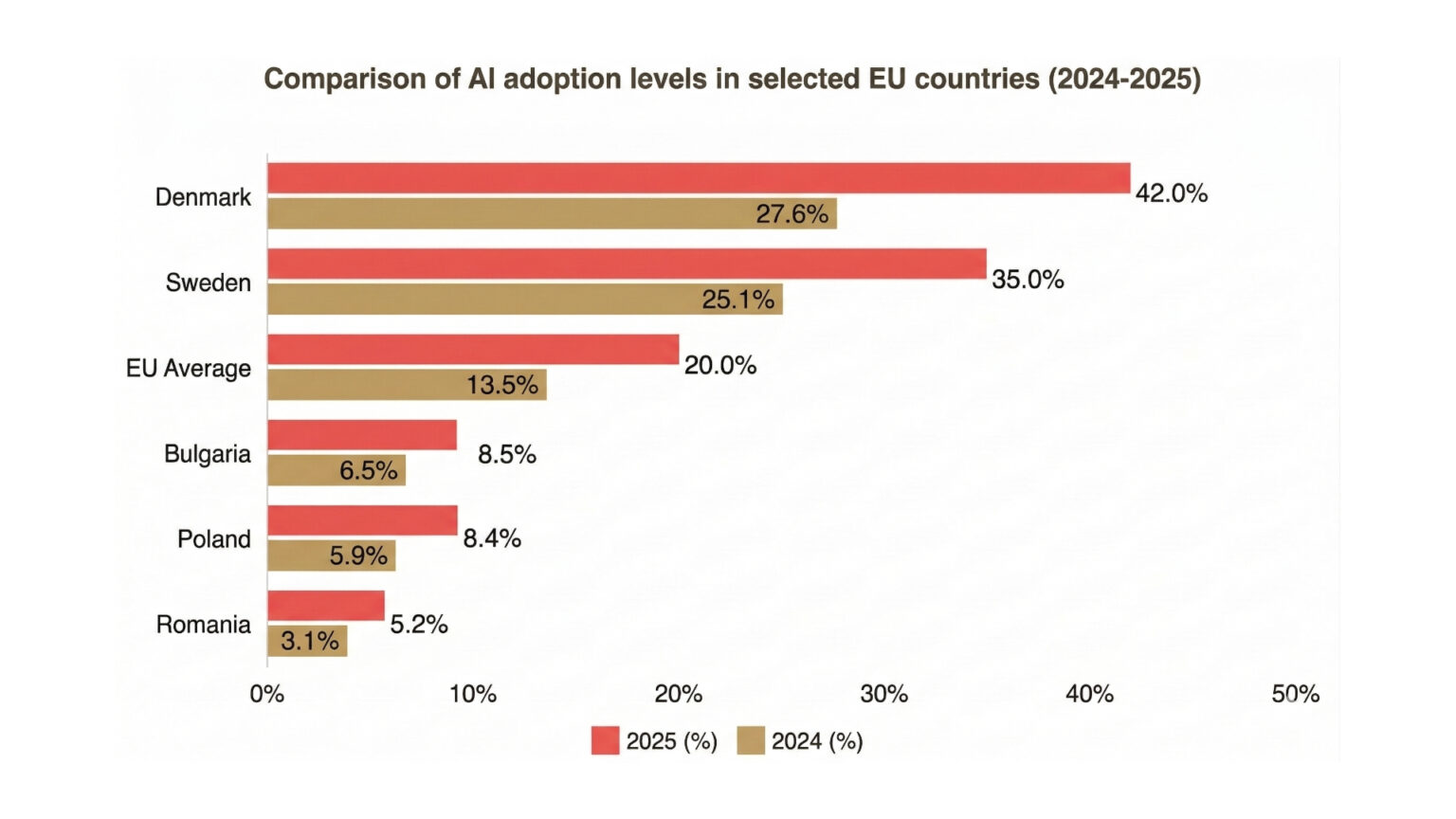
According to Eurostat data for 2025, the percentage of businesses in the European Union (with more than 10 employees) using AI has reached a ceiling of 19.95%. Although this represents an increase from 13.5% the year before, this dynamic masks a massive stratification and the so-called ‘valley of death’ of AI projects. As the latest market analysis shows, only 33% of cognitive projects in large companies successfully move from pilot to full-scale production. What’s more, as many as 80% of companies that have deployed the new technology still have no measurable increase in productivity or impact on employment levels. Only 5% of pilot deployments are currently generating multi-million pound business value.
In this complex context, the position of the Polish market appears highly worrying. Official structural adoption rates for Poland for 2025 stopped at 8.36% (Eurostat data) to 8.7% (CSO data), leaving the country at the tail end of Europe. The 2026 reports of the Polish Economic Institute (PIE) indicate unequivocally: as many as 77% of Polish entities not using AI declare that they do not intend to implement these technologies until they are absolutely forced to do so by the market or by law.
AI adoption in Europe
To fully illustrate the market phenomena described, it is necessary to analyse the market structure emerging from the hard Eurostat data. The difference between the top of the table and the countries closing the gap is an eightfold technological gap. The Scandinavian countries have achieved success not by building their own capital-intensive foundation models, but through the agile integration of off-the-shelf external services. They create a highly receptive environment in which application innovation is a priority.
With a rate of less than 9%, Poland is moving at a pace that perpetuates its position on the fringes of Europe’s digital middle ground. This calls for reflection, as the consequences of this lag, combined with an ageing population, will directly affect the competitiveness of Polish exports.
The Polish paradox
A superficial comparison of nationwide indicators with data for the largest corporations may lead to misleading conclusions. While Poland performs extremely poorly in macroeconomic terms, there is a clear upturn in the segment of the largest companies. The research shows that 34% of medium and large companies on the Vistula River have implemented their first AI-based solutions. As many as 75% of large entities declare the implementation of AI or advanced analytics projects, and 55% of them have or are currently building a formal strategy in this regard.
So why are productivity rates stagnating? European business has fallen into the trap of the so-called ‘valley of death’. Initiatives most often end up in closed, secure Proof of Concept experiments. Companies face gigantic problems in scaling these solutions across the entire organisational architecture. The main reasons for this are: outdated internal data infrastructure, huge API costs when used en masse, and the difficulty of integrating algorithms into existing, archaic ERP or CRM systems. As a result, AI is often seen by boards as a curiosity driven by stock market investors’ expectations, rather than a tool to realistically reduce operational costs.
BYOAI and Shadow AI
The most fascinating and yet most dangerous trend of 2026 is the massive explosion of the BYOAI (Bring Your Own AI) phenomenon, closely related to the concept of ‘Shadow AI’. As boards debate strategies, compliance procedures and budgets, employees have taken matters into their own hands.
Officially, many organisations prohibit or strongly restrict the use of public generative models for fear of data leakage. Unofficially – they are used by the majority of corporate employees. Analyses from 2026 show that nearly 78% of office workers who rely on artificial intelligence on a daily basis use their own private accounts and applications for this purpose, often without the knowledge of IT departments. Moreover, in Poland, as many as 80% of employees still do not have formal permission from their employer to use GenAI as part of their job duties.
This trend has a twofold consequence. On the one hand, it demonstrates the gigantic need to optimise one’s own work. On the other, it generates a powerful risk of injecting sensitive financial data, source code or trade secrets into open neural networks. Boards of directors who, in 2026, continue to pretend that the Shadow AI phenomenon in their organisations does not exist, risk not only losing their digital sovereignty, but also severe penalties for breaches of confidentiality. The paradigm shift urgently requires a shift from categorical bans to building secure, corporate equivalents of popular tools (e.g. private instances of language models in the cloud).
Where does AI actually work?
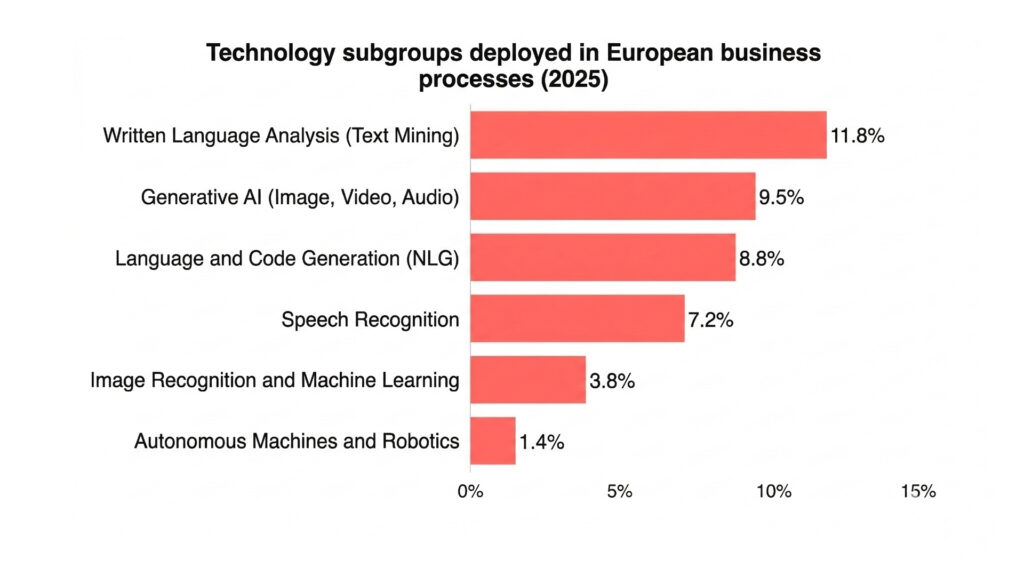
An analysis of the types of artificial intelligence being deployed sheds light on a clear evolution of the market – from complex engineering algorithms to democratised, natural language-based consumer interfaces. Among European companies, it is dominant:
- Written Language Analysis (Text Mining): The foundation of digitisation, used in the European Union for document categorisation, contract risk assessment and compliance automation.
- Generative AI for multimedia and language: Text, image and code generation are the areas recording the highest growth rates. They mainly serve marketing, customer service and developers.
- Back-office processes: This is where the real value is hidden. Companies see the greatest potential in process automation (AI-supported RPA) and improved predictive quality, which 48% of high-tech organisations are already using. Areas such as HR, logistics and finance are slowly catching up with front-office departments.
Despite these applications, a staggering 56% of the companies surveyed said they had achieved only partial or no benefits from their implementations. This shows that simply subscribing to an AI assistant does not restructure work deeply enough to noticeably increase EBITDA ratios.
Main barriers to development in 2026
2026 precisely defines four key barriers holding back the European and Polish economies from entering the fully cognitive era.
1 Legal Rubicon: Entry into force of the EU AI Act
August 2026 is a time caesura in the European technology market. This is when transparency rules and regulations targeting high-risk artificial intelligence systems from the EU’s high-profile AI Act regulation come into full force. Entrepreneurs collide en masse with the need for complex technology audits and risk classification of deployed systems. If company algorithms (e.g. in credit scoring systems or automated CV selection) are classified as high-risk solutions, the act forces continuous human oversight, strict risk management procedures and rigorous record-keeping. The fear of gigantic financial penalties and new management liability paralyses investment decisions in many boards, which prefer to put innovation on hold in favour of so-called ‘legal compliance’.
2. competence gap
The most serious operational bottleneck remains the talent deficit. As many as 69% of Polish organisations report serious difficulties in recruiting and retaining AI experts. The situation is dramatic even in the wealthy financial sector, where only 10% of entities report adequate staffing in this area. This is leading to a devastating war for talent. Salaries for experienced machine learning engineers in Poland in 2026 reach ceilings in the order of PLN 23,000 – 30,000 per month, recording annual increases of often 20% in the face of pressure from global corporations and remote working. For the traditional SME sector, these rates are completely prohibitive.
3. alarming demographic indicators and generation gap
Analysis of the structure of the use of cognitive tools exposes the painful truth about the Polish education system and the entry of young people into the labour market. European data from 2026 shows that only 49.3% of young Poles (aged 16-24) actively use generative artificial intelligence tools. When juxtaposed with the EU average in this age group of 63.8% (and results of the order of 78% – 83% recorded in the Czech Republic, Estonia or Greece), Polish youth ranks among the last in Europe. This means that the Polish labour market will not be fed by a mass wave of “digital natives” proficient in automation, which in the perspective of the ageing society heralds a deepening crisis of hands for work.
4. the illusion of immediate profit
The final barrier is the aforementioned disappointment with financial performance. Businesses are discovering that the technology is not a magical remedy. The operational costs of the cloud, the processing of API queries and the need to restructure dirty historical data often outweigh the savings generated from reducing headcount or speeding up service.
Given the market reality that the transformation has gone from a phase of joyful testing to a phase of hard cost-counting and regulatory adjustments, company boards should review their strategies. What is worth focusing on?
Legalise and structure ‘Shadow AI’: Categorical bans on the use of external AI tools are a dead law, commonly broken by 80% of the workforce. It is worth considering buying access to secure, isolated corporate environments, making them available to staff with appropriate permissions and formally integrating them into office process flows.
AI Act audit and compliance as a priority: With the enforcement requirements of the AI Act regulation (August 2026) looming large, every organisation needs to immediately catalogue the algorithms in its inventory. It is necessary to categorise them into appropriate risk profiles. Negligence in this area can result not only in sanctions, but also in the forced shutdown of key elements of e-commerce or HR infrastructure.
Moving from point solutions to a data ecosystem: The success of Scandinavian companies proves that implementing AI ‘ad hoc’, without structuring the data architecture of the entire company, leads to burning through budgets in the ‘valley of death’. Data Lifecycle Management should be a priority for 2026-2027. An algorithm is only as smart as the clean, structured and integrated data on which it is based.
Focusing on hard ROI rather than image innovation: The time of companies bragging about the mere implementation of any chatbot is irrevocably passing. New technology projects must have clearly defined financial KPIs even before the Proof of Concept phase begins. Investments should be channelled into back-office solutions (supply chain forecasting, audit automation and financial controlling), not just facade marketing.
European business has reached a tipping point. The division into technological empires and digital provinces is becoming a reality. With demographics working against the employee market, cognitive automation, bypassed by a wide margin, is becoming the only survival policy for thousands of companies in lagging markets.