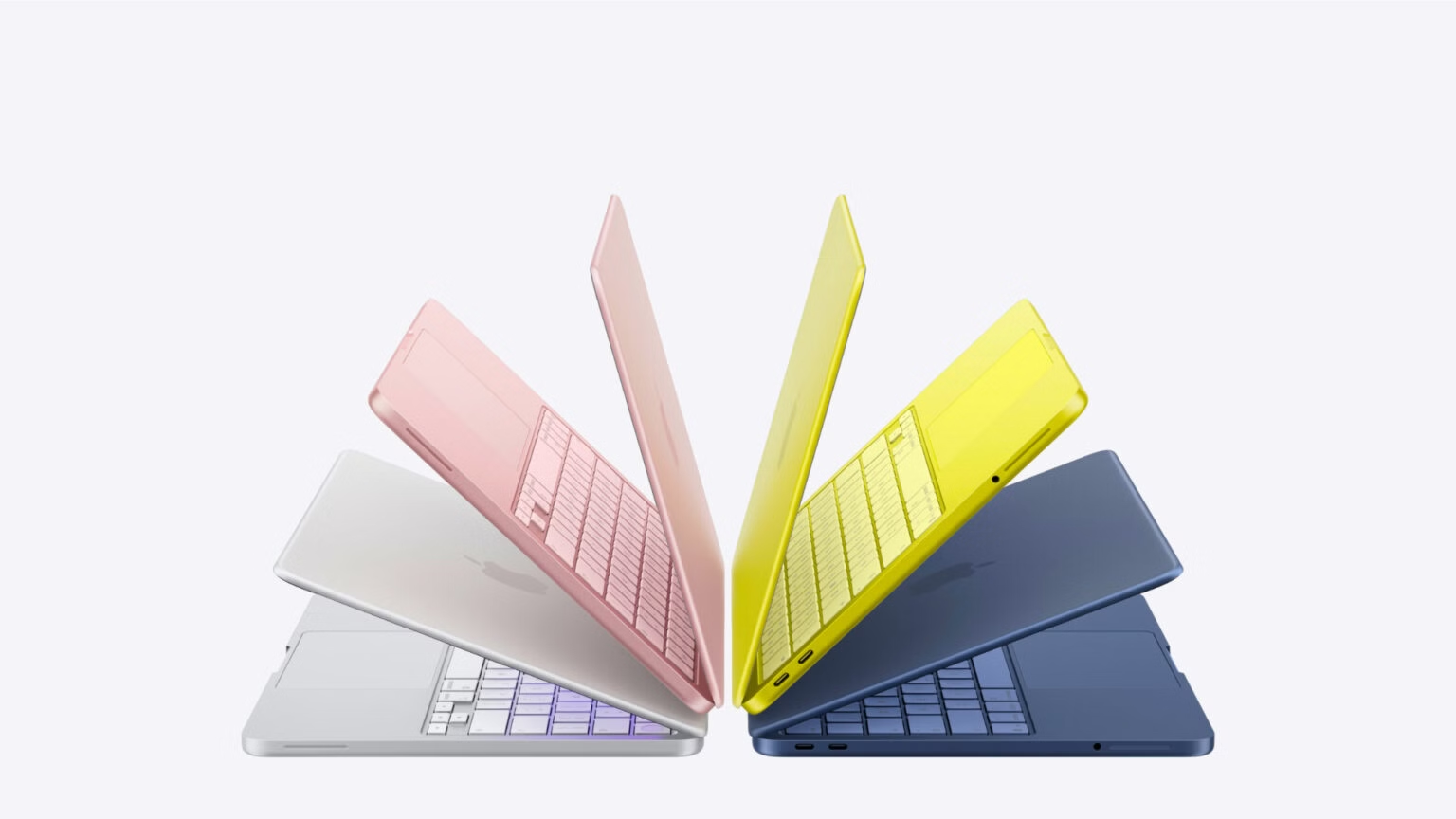
For years, Apple has balanced a fine line between sophisticated design and hardware durability, often sacrificing the latter for aesthetics. But the launch of the MacBook Neo signals a pragmatic shift in Cupertino’s hardware philosophy. Priced at a competitive £2999, the device has been named Apple’s most repairable laptop since 2012, according to a recent analysis by iFixit.
For a company that once pioneered the implementation of proprietary pentalobe screws and aggressive adhesive bonds, the internal architecture of the Neo model is a surprising departure from the norm. Apple has replaced glue and rivets with traditional screws at the battery and keyboard mounts – a move that significantly lowers the entry threshold for servicing hardware. Key components such as the camera and Touch ID sensor have become modular, making them easier to replace in high-use environments such as school districts.
The challenge to Chromebooks
This design twist is not sentiment, but a battle for market share. By hitting the $500 price ceiling, Apple is entering directly into territory dominated by Google’s Chromebooks. In the education sector, the key indicator is total cost of ownership. As Kyle Wiens, CEO of iFixit, notes, schools often rely on interns to maintain hardware fleets. A laptop that requires a specialist tanner to open the case is a burden; a laptop that can be serviced with a simple screwdriver becomes a scalable asset.
The bottleneck of artificial intelligence
Despite these advances, Cupertino engineers haven’t completely abandoned their restrictive practices. The MacBook Neo received a 6/10 repairability rating from iFixit – a solid score for Apple, but still second only to the 9/10 marks regularly earned by the ThinkPad line from Lenovo.
The main point of contention remains the integration of 8GB of DRAM directly into the processor. While this unified memory architecture provides the speed that Apple is renowned for, it prevents any expansion after purchase. In an era where Apple is betting on private, local AI, this rigid memory limit could become a trap for premature product obsolescence. As local AI models go from strength to strength, 8GB may prove insufficient, limiting the Neo’s usefulness long before the physical case wears out.
For corporate and education customers, the MacBook Neo is a win in the durability category, but a calculated risk in terms of long-term performance. Apple has made servicing the hardware simpler, but the real test will be whether the components can keep up with the demands of software in the coming years.