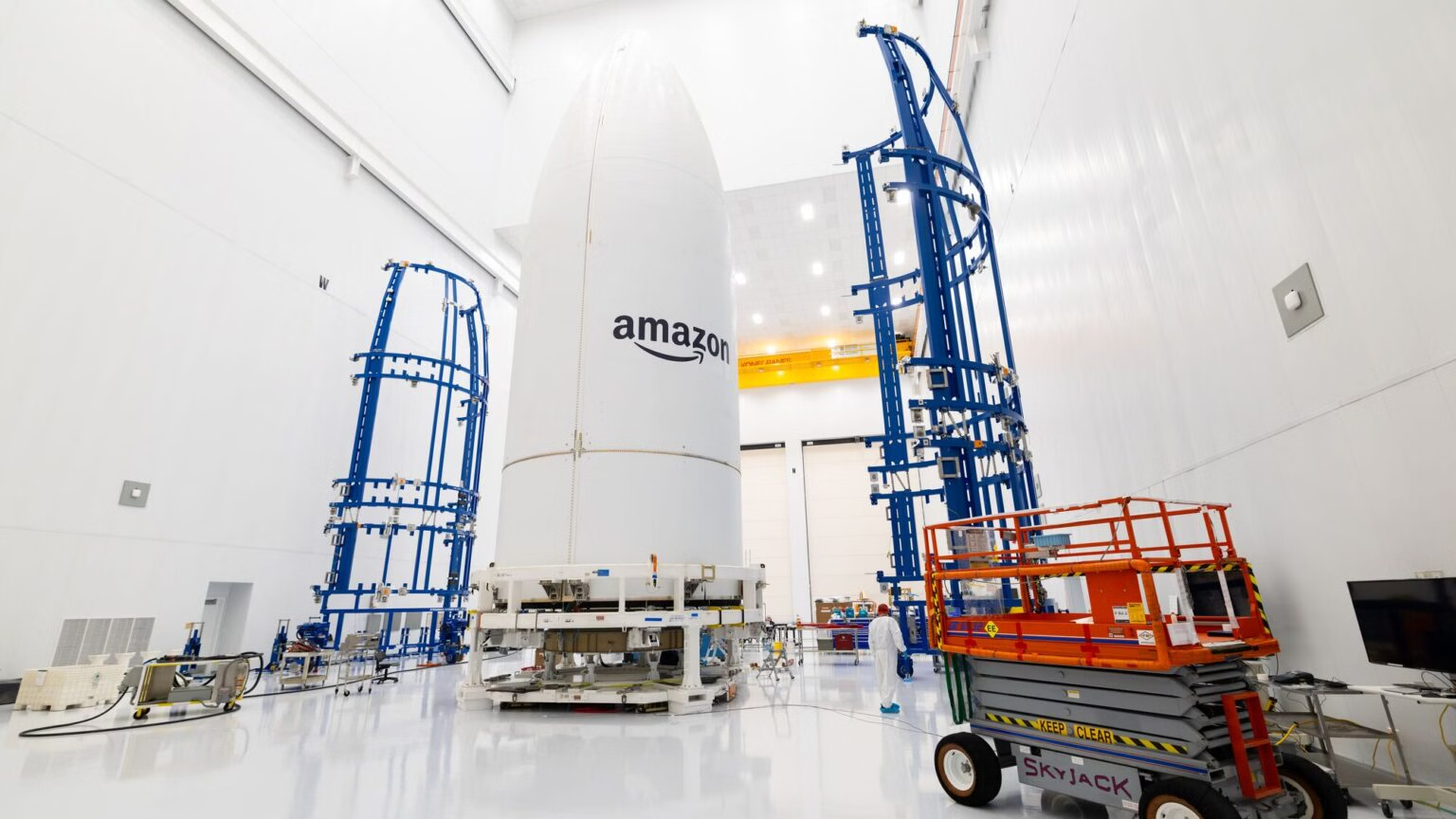
Amazon’s $11.6 billion acquisition of Globalstar is a trategic blow to the direct-to-device (D2D) market. The deal has the potential to change the balance of power in low earth orbit (LEO), although the Seattle-based giant still faces a fundamental logistical challenge.
Strategic gap and the spectre of D2D
The main motivation behind Globalstar’s purchase is its desire to rapidly deploy services that allow smartphones to connect directly to satellites, bypassing traditional cell towers. While Starlink focuses on broadband for home and business terminals, Globalstar has key radio spectrum resources ideal for low-bandwidth data transmission, essential for emergency services or communication in dead zones.
For Amazon, whose Kuiper project is still in its infancy, this is a technological leap. The integration of Globalstar’s twenty-four satellites into the network under construction will allow the company to offer D2D functions as early as 2028. This is significant because Starlink already operates a network of 10,000 units, serving millions of users and building alliances with terrestrial operators.
Alliance with rival under Apple’s watch
The deal has an intriguing subtext in its relationship with Apple. Globalstar has been a mainstay of the iPhone’s emergency functions for years, and Apple itself has invested billions of dollars in the company with a minority stake. Amazon, by taking control of Globalstar, becomes a de facto infrastructure partner of its big Cupertino competitor. The declaration of continued partnership with Apple suggests that Amazon intends to profit from operating the iPhone ecosystem while building its own alternative to Starlink.
The launch barrier remains intact
Despite a massive financial investment, Amazon has not solved its biggest problem: the lack of efficient launchers. While SpaceX uses its own fleet of Falcons, Amazon is dependent on external suppliers and is still waiting for New Glenn from Blue Origin to become fully operational.
The numbers are inexorable – Amazon has so far deployed a fraction of its planned constellation of 3,200 satellites. Unless the rate of launches increases dramatically, SpaceX’s advantage may become impossible to close. The purchase of Globalstar gives Amazon valuable radio bandwidth and technology, but does not solve the problem of physically placing equipment in orbit. It is this ‘structural gap’ in space logistics that remains the weakest point in Bezos’ strategy.