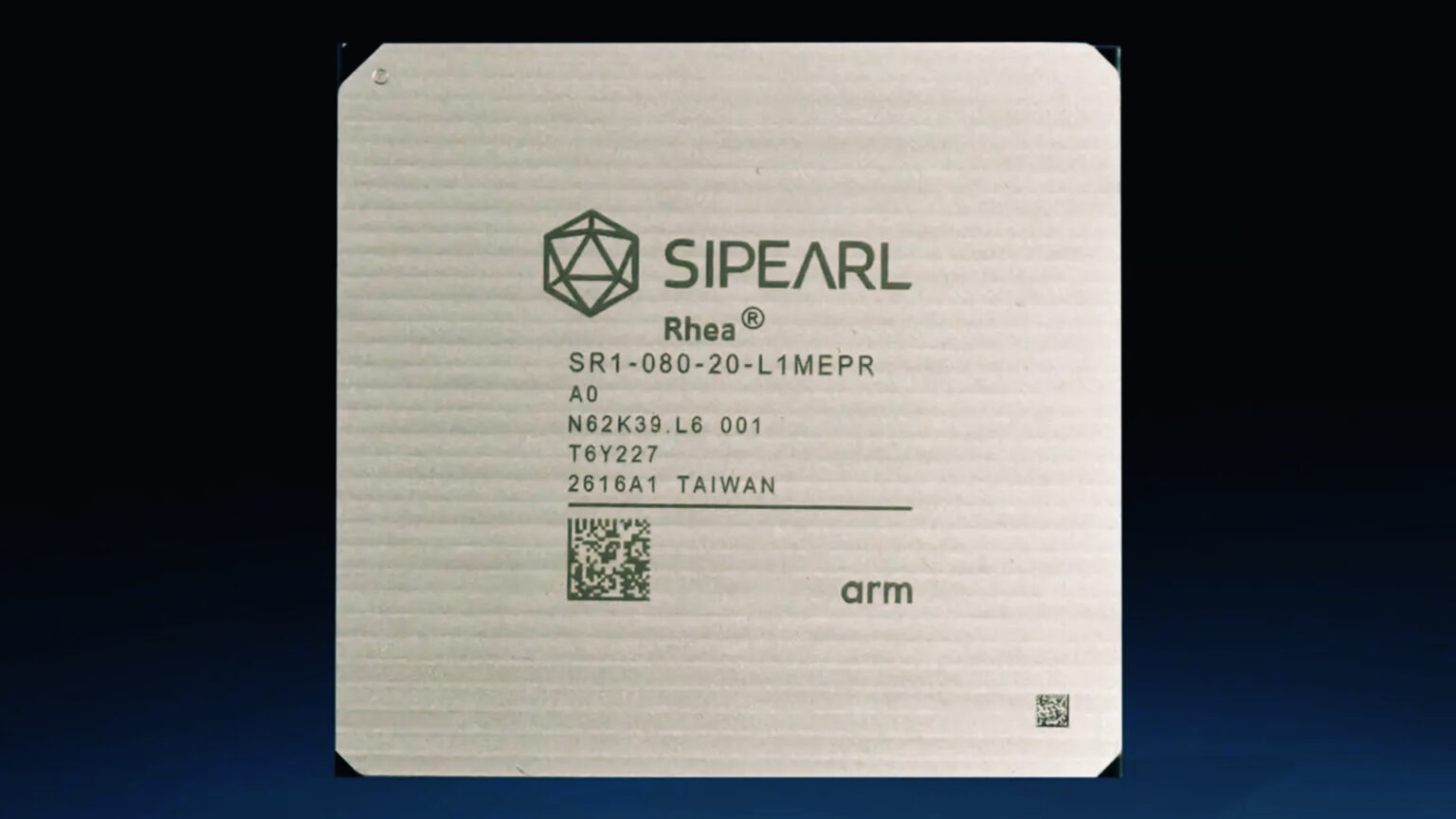
Europe’s digital independence has just taken physical shape, although its delivery was particularly painful. French startup SiPearl has announced that test units of the Rhea1 processor – the most complex chip designed on the Old Continent – have left the factory and passed the first-launch procedure. This is a milestone for the European Processor Initiative (EPI). However, time passes differently in the high-tech world. By the time Rhea1 goes on mass sale at the end of 2026, its architecture will have grown old. Isn’t the project that was supposed to make us independent from the US and Asia becoming a monument chasing a runaway train?
Silicon reporting from the front, or success with a slip-up
It has happened. The physical silicon that engineers from a European consortium have been thinking about for years has finally ‘fired up’. SiPearl confirms that the first engineering samples work stably, draw current and behave exactly as predicted by computer simulations. Champagne corks have certainly popped in the corridors of the European institutions. And no wonder – an architecture capable of handling the most demanding scientific computing has been created from scratch.
The problem is that this champagne may taste a little weathered.
Let us recall a brief history lesson. The European Processor Initiative (EPI) launched in 2018 with a clear and ambitious goal: to challenge the US dominance of Intel, AMD and Nvidia and secure the digital sovereignty of the European Union. The schedule was tight, but realistic. The first version of the processor, dubbed Rhea, was due to see the light of day in 2023.
Reality brutally verified these plans. Deadlines were pushed back time and time again. First to 2024, then to 2025, until finally the end of 2026 became a realistic date for general market availability. In the semiconductor industry, a three-year delay is a whole epoch. SiPearl’s success is thus unquestionable on an engineering level, but on a business level it carries a massive baggage of compromises.
Anatomy of a compromise: Will the Rhea1 architecture stand the test of time?
To understand why Rhea1’s delay is so painful, we need to look under its ‘hood’. At the heart of the European super-processor is the 80 ARM Neoverse V1 cores. When this chip was designed, it was the absolute pinnacle of technological capability in the High-Performance Computing (HPC) segment.
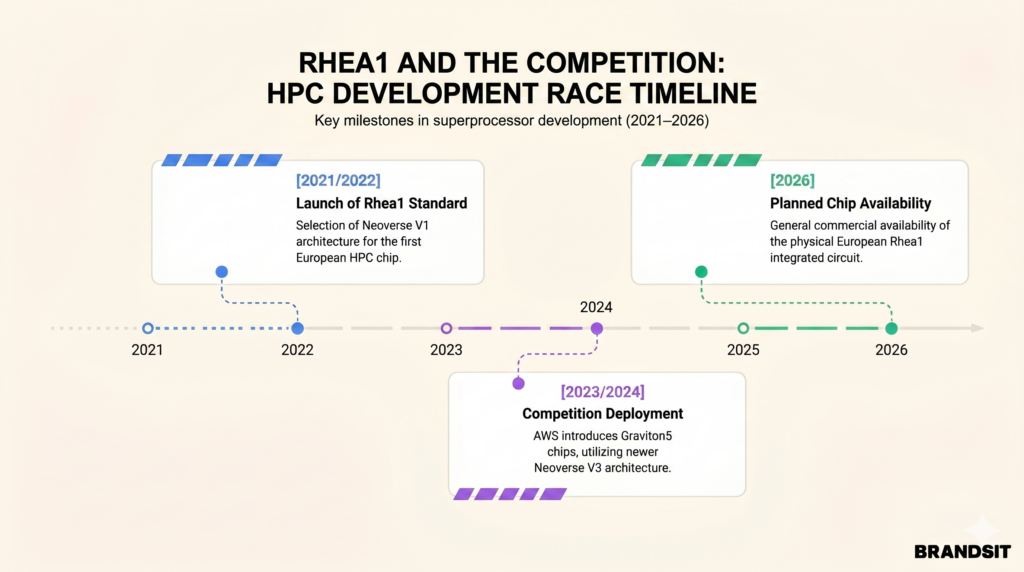
However, the technology world is not disappearing into a vacuum as Europe catches up. Let’s take a look at the market timeline:
- 2022: ARM unveils the Neoverse V2 architecture.
- 2024: Neoverse V3 enters the scene.
- Present: US cloud giants (so-called hyperscalers), such as Amazon Web Services (AWS), are mass-producing their own Graviton5 processors, based precisely on the Neoverse V3 architecture.
When Rhea1 goes on regular sale, it will be a design based on the architecture from two generations ago. It will not be a technological predator that will take the competition apart. It will be a reliable, capable, but nevertheless yesterday’s solution. For a commercial business that counts every watt of power and every millisecond of floating point operations, choosing an older architecture for “patriotic” reasons may be difficult to swallow.

Jupiter supercomputer: American muscle saves the situation
The best evidence of how market pragmatism has won out over political ambition is the story of the Jupiter supercomputer. It is the flagship project of the EuroHPC community venture. It was to be the first European exascale supercomputer, with SiPearl chips at its heart.
However, science and business do not tolerate a vacuum. As the Rhea1 processor kept falling behind, the Jupiter developers had to make a tough decision: either we wait for Europe and fall behind in AI and quantum physics research, or we buy the technology where it is available. Gate number two was chosen.
As a result, Jupiter has reached the exascale barrier, relying on American technology. The main module of this computational monster consists of 6,000 nodes equipped with Nvidia GH200 Grace Hopper superchips.
Where is Rhea1’s place in all this? The European processor has not been completely scrapped, but its role has changed dramatically. Instead of being the foundation of the entire system, Rhea1 will power an additional modular cluster of 1,300 nodes (two processors per node). So Europe built its own brain for the supercomputer, but by the time it delivered it, the patient had already been given a state-of-the-art US implant, which does most of the hard work.
The paradox of sovereignty: Designed in Paris, printed in Taiwan
The most fascinating part of the whole puzzle around Rhea1 is the semantics of the word ‘sovereignty’. The European Union very much wants to believe that it is creating an independent ecosystem. However, a glance at the supply chain exposes a painful truth.
SiPearl is a fabless company – meaning it has brilliant engineers who can design, draw and test the processor on computer screens. However, it does not have its own factory. When the moment came when the digital blueprints needed to be turned into physical silicon, the plans were sent to Hsinchu in Taiwan, to TSMC’s facilities.
This raises a fundamental question about the definition of independence:
- Is a chip designed in France, licensed in the UK (ARM), manufactured in Taiwan (TSMC) and working with US accelerators (Nvidia) realistically ‘European’?
- What happens in the event of a possible geopolitical conflict in the Taiwan Strait?
Europe today does not have a single factory (foundry) on its territory capable of physically producing such advanced chips. Building sovereignty without its own production capacity is akin to designing a luxury car when the only wheel supplier in the world lives on the other side of the globe and has a mass of other customers.
An expensive lesson in humility we have had to learn
Should the Rhea1 project then be considered a failure? Absolutely not. A critical assessment of the delays and technological backwardness is necessary, but it must not obscure the bigger picture.
Rhea1 is a powerful, invaluable testing ground for Europe. Designing advanced HPC processors is elite knowledge. By going through the whole painful process – from the first sketches of 2018 to the physical launch of the chip – the European EPI institute and SiPearl have created unique know-how. Personnel were educated, tools were tested, mistakes were made and lessons were learned. Without this first, even if stumbled, step, Europe would be forever out of the league of designers of the world’s fastest integrated circuits.
The lesson for the future, however, is brutally simple: in the semiconductor industry, patience is not a virtue – it is a death sentence. If the next generations of processors (Rhea2 and beyond) are to realistically compete for market contracts, the production cycle must be halved. Europe is slowly learning to walk in the world of superprocessors. The problem is that the rest of the world is already running a killer AI marathon at the same time. It’s time to stop marching – we need to start running.