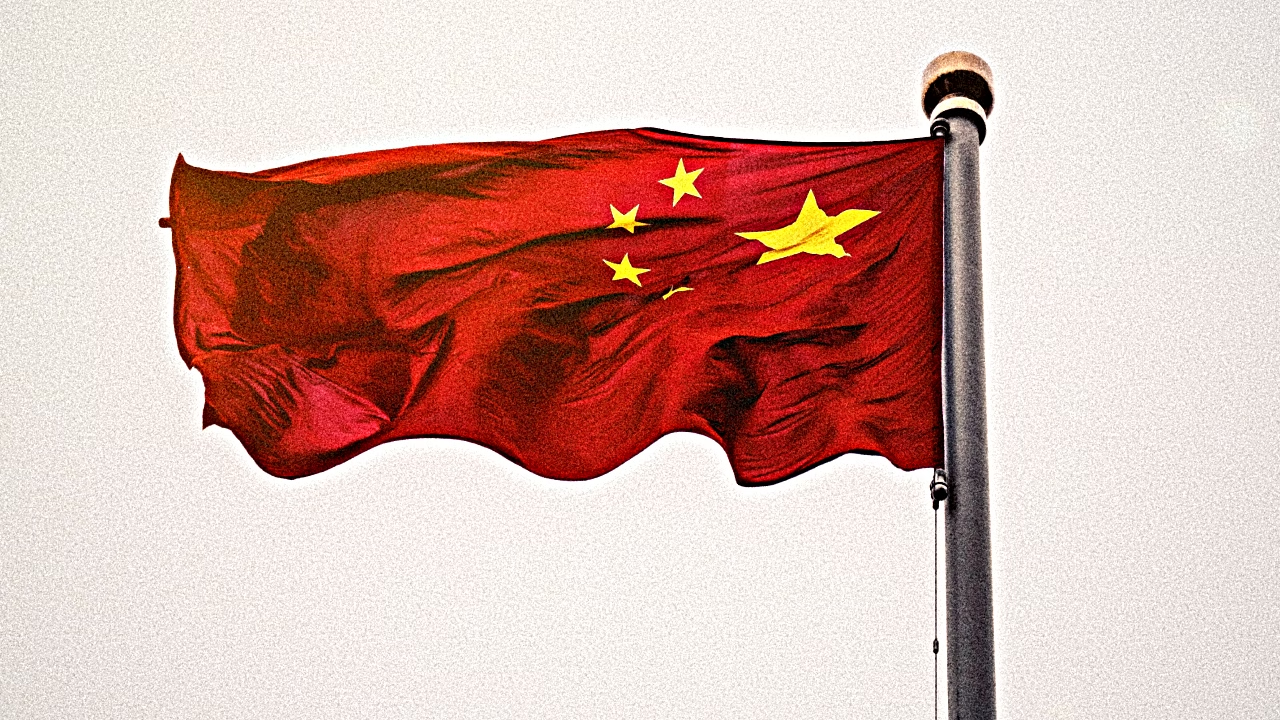
For decades, the European economy has been based on a paradigm of maximum openness, often at the expense of its own industrial base. Today, we are witnessing a historic turnaround. The regulations proposed by Brussels – from tougher cyber security standards to the ‘Buy European’ (Industrial Accelerator Act) – are not just a defensive response to global turmoil, but above all an ambitious plan to reclaim Europe’s role as a technological leader. Beijing’s vehement opposition, which has taken the form of diplomatic warnings in recent days, is the best evidence that the European Union has finally begun to define its national interests effectively.
Power diplomacy: Brussels begins to speak with one voice
China’s Ministry of Commerce and diplomats in Beijing accuse the EU of ‘double standards’ and violating free trade rules. But from an analytical perspective, what Beijing calls discrimination, for European business is a levelling of the playing field. For years, Chinese giants have benefited from subsidies and a protected internal market, expanding in Europe on terms that were unattainable for EU companies in China.
China’ s current diplomatic offensive – letters to the European Commission and lobbying in capitals – confirms that the EU’s de-risking strategy has real leverage. The EU is ceasing to be merely a market and is becoming a standard-setter, which in the long term will ensure greater predictability and operational stability within the community.
Cyber security as a foundation for trust
A key pillar of the new strategy is the elimination of components from ‘high-risk’ suppliers in critical sectors. China is calling for these definitions to be removed, seeing them as a barrier to companies like Huawei. However, technological sovereignty is not a luxury but a cornerstone of national security, especially in times as geopolitically unstable as the present.
From a market perspective, this process is stimulating a new wave of innovation within the EU:
- Support for homegrown integrators: Reducing the share of non-trusted suppliers opens up space for European companies such as Ericsson and Nokia, as well as the growing Open RAN sector.
- Integrity by design: European safety standards are becoming a global quality certificate, which could become a new export asset for EU technology.
Industrial Accelerator Act: A new era for European innovation
The ‘Buy European’ law is not an act of protectionism, but a strategy to build a healthy industrial ecosystem. Using public procurement to promote local manufacturing and low-carbon standards is a mechanism that aims to:
- Stimulating the energy transition: Promoting goods with a low carbon footprint forces global suppliers to innovate, while giving a technological edge to European manufacturers.
- Protection of intellectual property: Beijing’s opposition to technology transfer legislation shows that the EU is effectively safeguarding its most valuable assets against uncontrolled leakage of know-how.
The introduction of a requirement for EU-produced content in public contracts is not a barrier, but an invitation to real investment on the continent. Companies that choose to build factories and research centres in Europe will gain stable and preferential access to one of the world’s largest markets.
Investment in stability
Although China is threatening ‘countermeasures’, the analysis of economic interdependence indicates that both sides have too much at stake to bring about a full-blown rupture of relations. For business, the following conclusions are key:
- Reshoring and Nearshoring: building industrial sovereignty in the EU will shorten supply chains, drastically reducing the geopolitical risks that have destabilised production in recent years.
- Growth of the local R&D sector: The need to replace some imported technologies with our own solutions will force an increase in R&D spending, which will raise the competitiveness of the European IT sector within a decade.
- New partnerships: Diversifying suppliers (e.g. towards India or Vietnam) in response to Chinese restrictions will make European companies more resilient to economic blackmail.
Empowerment through sovereignty
Building the ‘Digital Fortress of the EU’ is in fact building the foundations for a modern, independent and competitive economy. Transitional tensions with Beijing are the natural result of correcting long-standing imbalances. For European entrepreneurs, Brussels’ current course means a return to the highest stakes game – not as sub-suppliers, but as technology owners and standard setters.
Strategic autonomy does not mean isolation, but the right to choose partners on their own terms. In the long term, it is this assertiveness that will make Europe a more attractive and credible place to do business, where innovation goes hand in hand with security and values.