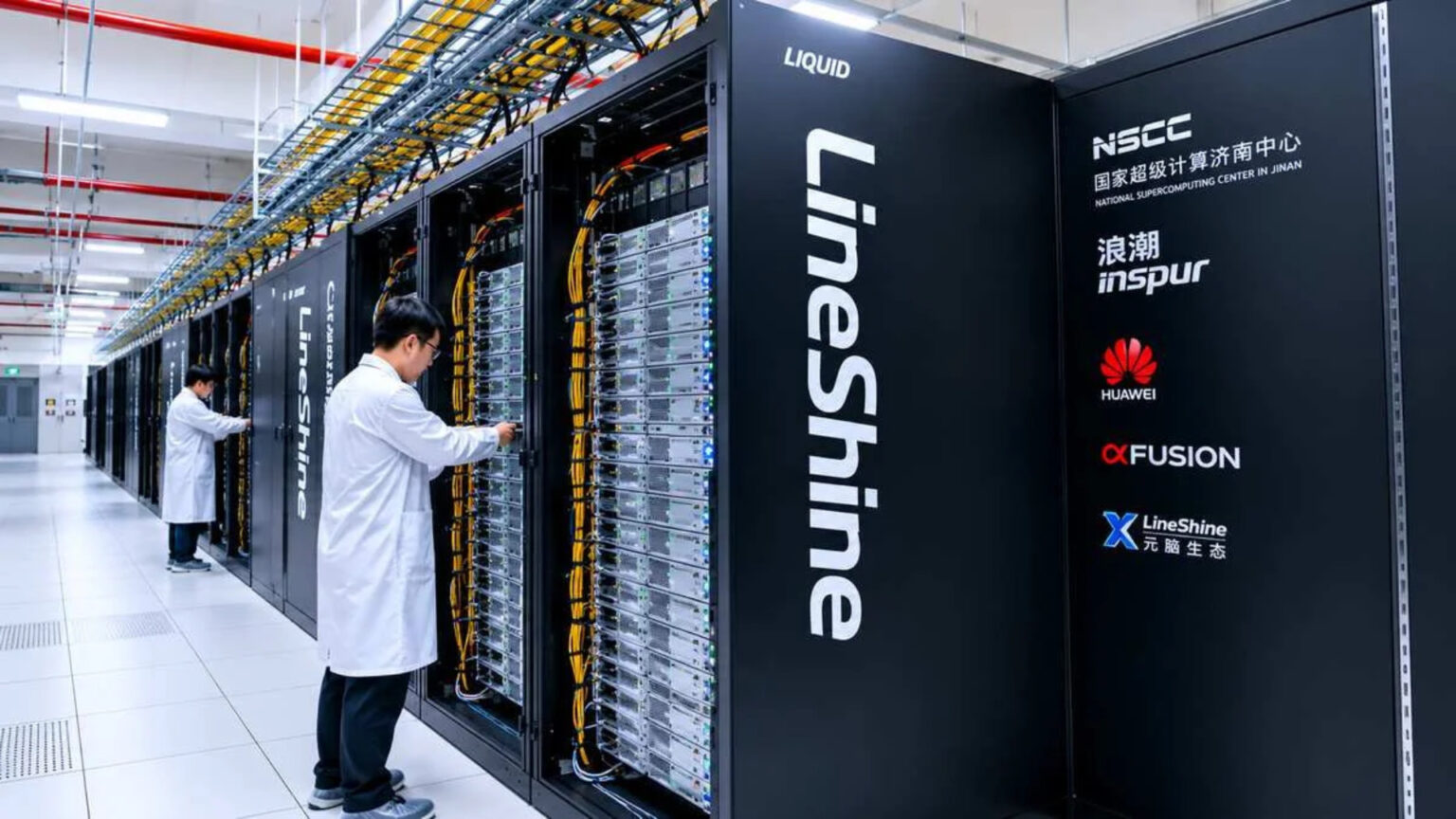
The Chinese supercomputer LineShine has debuted at the top of the latest TOP500 list, announced during the ISC 2026 conference in Hamburg. This is a landmark moment for the high-performance computing market. For the first time since 2017, a system from China has topped the ranking, which has for years been regarded as one of the benchmarks of nations’ technological ambitions.
LineShine operates at the National Supercomputing Centre in Shenzhen and was built by the Shenzhen Cloud Computing Centre. In the High Performance Linpack test, it achieved 2.198 exaflops, overtaking the US-based El Capitan from Lawrence Livermore National Laboratory. This means that the Chinese machine is the first in the history of the TOP500 to exceed the two-exaflops mark for sustained double-precision performance, using only CPUs.
It is the architecture itself that is more important here than the ranking. At a time when much of the industry is focusing on GPUs and AI accelerators, LineShine is relying on its own LingKun platform, LX2 processors, LingQi interconnect and the Kylin system. The machine has nearly 13.8 million cores and draws around 42.2 MW of power. It is therefore not an example of the most energy-efficient approach, but it demonstrates that China is capable of building an exascale-class system without relying on Western accelerators.
For the US, this marks the loss of the top spot, but not the loss of its leadership position across the entire sector. El Capitan, Frontier and Aurora occupy second, third and fourth place respectively. All three operate in US laboratories and remain key infrastructure for science, energy, defence and advanced simulations. Fifth place is held by the JUPITER Booster in Jülich, Germany, the first European exascale system in the TOP500.
The new list clearly shows that supercomputers are no longer developing according to a single pattern. The top ten includes systems based on AMD processors, Intel chips, NVIDIA’s Grace Hopper architecture, Japanese Fujitsu A64FX processors and bespoke Chinese solutions. HPE remains the leading integrator at the top of the rankings, but the technological lead is spread across several camps. AMD has a very strong position in exascale and sub-exascale systems, NVIDIA is growing thanks to the combination of HPC and AI, and Intel continues to feature in major government projects.
LineShine also leads in the HPCG benchmark, which better reflects selected workloads typical of real-world scientific applications. At the same time, its weaker performance in mixed-precision tests highlights the limitations of a CPU-only design. In other words, the Chinese system is very strong in classical HPC, but does not necessarily set the standard for the infrastructure used to train the largest AI models.
Energy efficiency remains a secondary consideration. The Green500 ranking continues to be led by smaller European systems based on the BullSequana XH3000 platform and NVIDIA Grace Hopper chips. This is an important signal for data centres, as the costs of electricity and cooling are becoming just as significant as computing power itself.
Poland’s presence in global HPC is more modest, but still noticeable. According to Cyfronet AGH, the June 2026 list included three systems from Kraków: Helios GPU, Athena and Helios CPU. They ranked 116th, 305th and 351st respectively. This is not at the level of the exascale race, but it is of practical significance for national science, AI projects, industrial simulations and European research infrastructure.
The key takeaway from this year’s list is simple: supercomputers have become a battleground for technological, energy and geopolitical competition all at once. China has regained first place, the US maintains the depth of its infrastructure, Europe is building its own position, and smaller countries, including Poland, are fighting for access to the computing power needed for science and the economy.