
Artificial intelligence is ceasing to be a tool used only by new technology enthusiasts. The latest On Board Think Kong survey shows that Poles are increasingly using AI when making purchasing decisions, and the use of such tools today goes far beyond electronics and white goods.
The ‘Shopping with AI’ report shows that 38 per cent of respondents see the usefulness of artificial intelligence when buying electronics and white goods. This was followed by travel and leisure (33 per cent) and home and garden equipment (30 per cent). Fashion and beauty (26 per cent), health and pharmacy products (24 per cent) and groceries (20 per cent) also ranked high. Only 19 per cent of respondents do not see the use of AI in any shopping category.
The results are part of a broader trend observed in the market. In the previous part of the OBTK survey, as many as 61 per cent of Poles declared that they had used AI tools in the past six months when planning their purchases or making purchasing decisions. These were most often used to compare offers, analyse reviews and assess the cost-effectiveness of products.
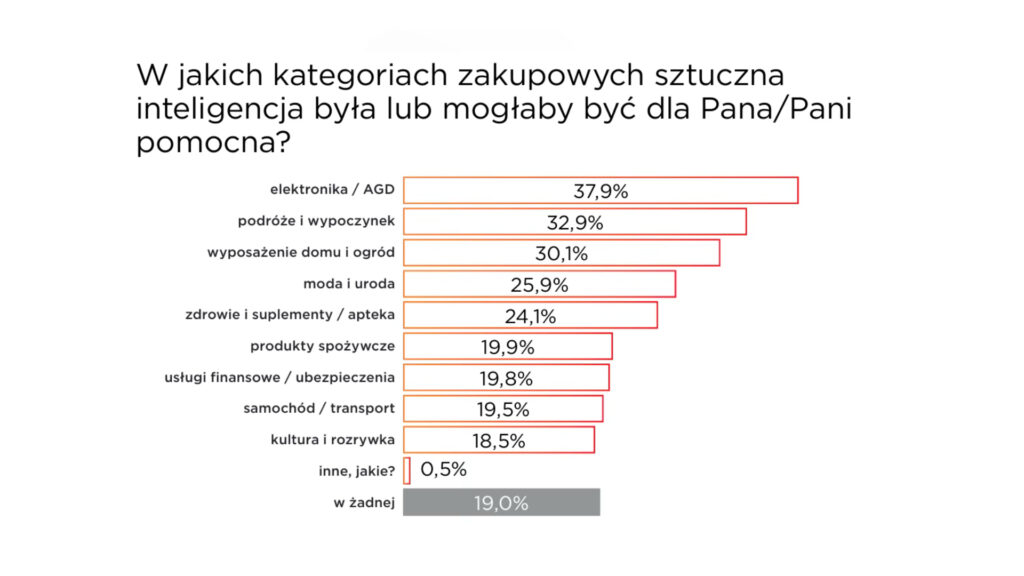
The survey also shows differences between men and women. Women are clearly more likely to use AI support for purchases related to fashion and beauty. This was indicated by 33 per cent of female respondents compared to 18 per cent of men. Men, on the other hand, are more likely to use AI when choosing electronics and white goods. In the case of travel, home furnishings or food products, there is little difference between the sexes.
For companies, this means a change in the way they reach customers. Increasingly, the purchasing process starts not with a search engine, but with a question directed to a chatbot. Experts point out that the presence of a brand in the answers generated by AI models is becoming a new element of competition for consumers’ attention.
The survey was conducted by SW Research using the CAWI method in April 2026 on a representative sample of 830 adult Poles. Its results suggest that AI is increasingly becoming an everyday tool to support purchasing decisions – both for big spending and during everyday lifestyle choices.