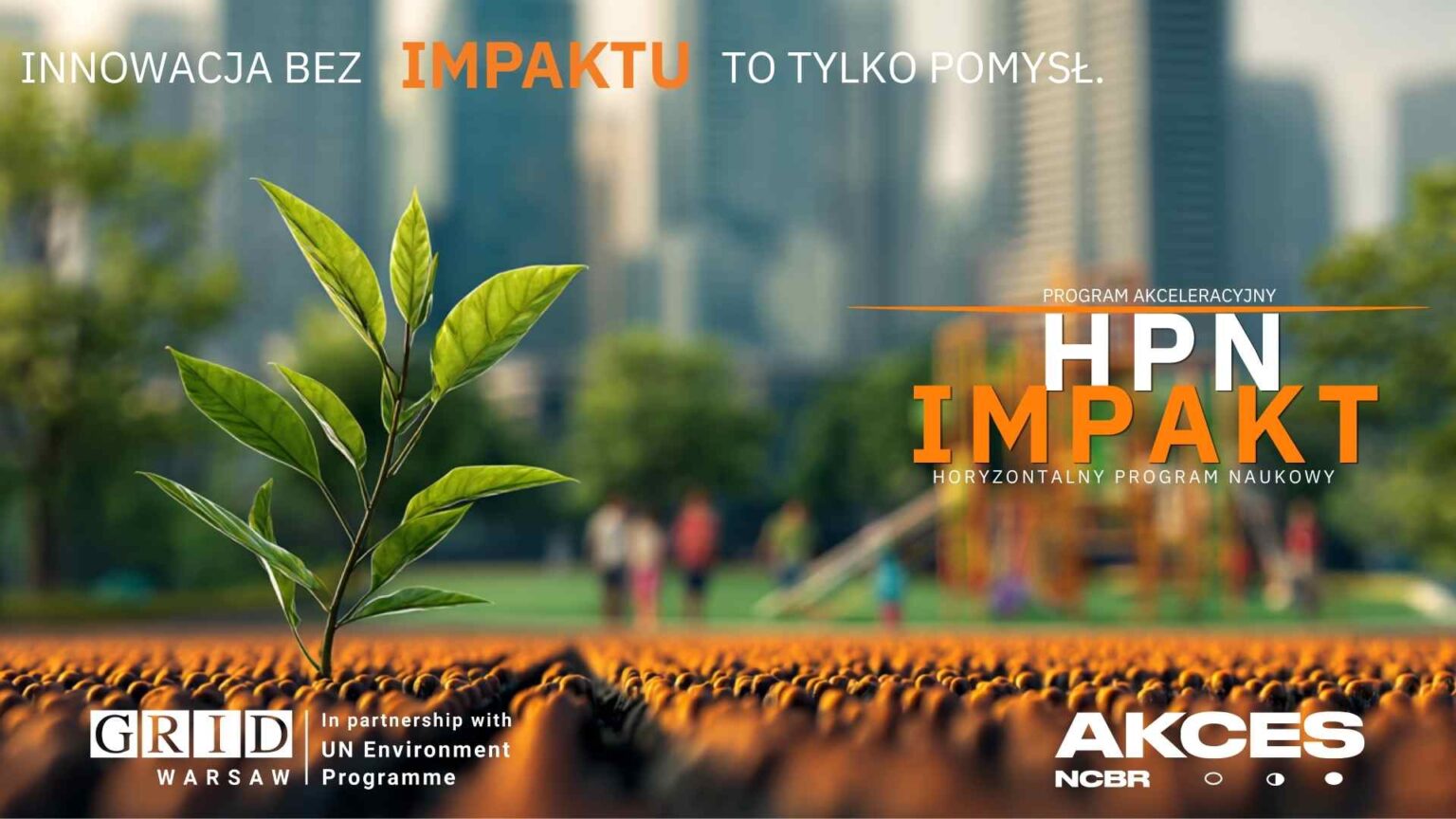
Akces NCBR, the market arm of the National Centre for Research and Development, has announced a call for applications for the HPN IMPAKT programme. This initiative is not just another grant competition; it is an attempt to formalise ‘impact’ as a key business performance indicator.
The mechanism of the programme is clear. The organisers are looking for solutions at technology readiness levels from TRL 3 to 8, which means that both advanced prototypes and products close to commercialisation are of interest. The key differentiator of this edition, however, is the scoring system: projects that can prove their real social or environmental impact will be given the highest priority.
Partnership and hard currency
In order to avoid the trap of ‘impact washing’, Akces NCBR has established cooperation with UNEP/GRID-Warsaw. The participation of the centre affiliated to the United Nations Environment Programme is to guarantee that declarations about the pro-environmental nature of the technology will be verified by experts. As Maria Andrzejewska, Director General of UNEP/GRID-Warszawa points out, innovations must accelerate systemic transformation and not just look pretty in ESG reports.
For startups and research teams, a package worth PLN 400 000 is at stake. This consists of a direct grant of PLN 300 000 and mentoring support valued at PLN 100 000. At a time of a more cautious approach by VC funds to early-stage startups, such non-dilutive (non-capital dilution) funding represents a significant liquidity injection for deep-tech (deep-tech).
Horizontality as a business opportunity
Arleta Malasińska, CEO of Akces NCBR, emphasises the horizontal nature of the call. The programme is not limited to one industry. Energy optimisation systems, as well as tools for increasing the availability of public services or water retention technologies all stand a chance. This approach reflects a broader trend in global markets: investors are increasingly looking for solutions to fundamental problems that are resilient to cyclical fluctuations in the consumer sector.
The call for proposals remains open until 31 May 2026. For the Polish R&D sector, this is a moment of testing – whether it can turn scientific ideas into measurable change that will defend itself on the free market.