Economic uncertainty is increasingly acting not as a brake on businesses, but as a test of their maturity. KPMG’s global report,‘Winners don’t wait: Transforming with confidence and clarity in volatile times’, reveals that 65 per cent of organisations are accelerating their transformation efforts despite changes in trade policy, geopolitical tensions and reduced market predictability. Only 17 per cent of companies are scaling back or putting such projects on hold.
This marks a significant shift in the way we think about transformation. Until recently, many companies viewed it as a costly modernisation programme that could be postponed until calmer times. Today, it is increasingly seen as a tool for safeguarding margins, improving efficiency and responding more quickly to changes in demand. Companies are therefore not abandoning their plans, but are reorganising them. According to KPMG, 39 per cent of organisations have reordered their priorities, opting for initiatives with a more predictable return on investment or lower risk. A quarter have reduced the number of key projects, whilst only 1 per cent have completely abandoned their transformation plans.
“The paradox of the current market is that many companies view uncertainty as a reason to slow down change, whilst for more mature organisations it serves as a catalyst for transformation. It is precisely during periods of greatest volatility that we can see which companies are able to make decisions based on data, priorities and a long-term vision, and which focus solely on current results.
This also applies to Poland. Many companies still focus on short-term efficiency, cost reduction or piecemeal technology implementations. Meanwhile, the experience of recent years shows that such an approach can lead to a loss of competitiveness. More and more organisations are investing in data, automation and AI, but the challenge remains in effectively implementing these changes. “There is a lack of a coherent transformation management model and clearly defined priorities linked to business value and customer needs,” says Maciej Bałabanow, CFA, Associate Partner, Advisory, Head of the Strategy Team at KPMG in Poland.
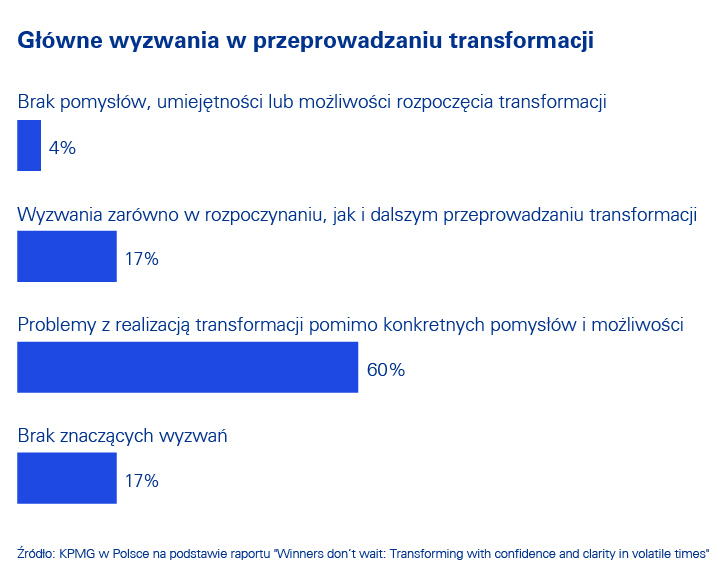
The biggest problem is no longer a lack of ideas. It is execution. As many as 60 per cent of managers admit that their organisations struggle to turn good concepts into tangible business results. This is consistent with a broader market trend: companies are investing in AI, automation and digital platforms, but often get stuck at the pilot stage. IDC points out that AI is moving from experimentation to enterprise-wide roll-outs, but this requires trusted data, a consistent architecture and clear decision-making rules.
The KPMG report also shows that organisations which do not treat transformation as a one-off project gain a competitive edge. Companies that are most confident in their position are more likely to utilise external partnerships, particularly technological ones, to scale up proven solutions. In this group, 46 per cent of respondents state that, should market conditions improve, their priority would be to further accelerate their transformation.
For Polish companies, the conclusion is simple: investing in technology alone is not enough. Transformation requires clear priorities, decision-makers and consistent management of the change portfolio. Otherwise, AI, automation and data analytics will remain costly one-off initiatives rather than a source of sustainable competitive advantage.
“Organisations worth looking up to are moving away from a project-based approach in favour of managing the entire transformation portfolio; they combine modernisation with the development of future-ready skills and use AI to boost efficiency and speed up decision-making. A cultural approach is key – transformation should be treated not as a one-off project, but as a core capability of the organisation,” says Maciej Bałabanow, CFA, Associate Partner, Advisory, Head of the Strategy Team at KPMG in Poland