For years, global technology providers enjoyed a fairly comfortable market division. The largest corporations received full enterprise support, long-term contracts, bespoke architecture and direct access to sales teams. Small businesses were directed towards self-service models: a simple subscription, a payment card, and implementation without a consultant. In between them were medium-sized enterprises, too complex to be treated like micro-businesses, but often too small to be treated as strategic accounts.
This model is beginning to crack. The mid-market is becoming one of the most important battlegrounds in the global IT market. Not because medium-sized companies have suddenly become fashionable, but because the economics of technology have changed. The cloud, cybersecurity, automation, ERP, data and artificial intelligence are no longer topics reserved for the largest organisations. At the same time, it is precisely medium-sized companies that find themselves in the most awkward position today: they must solve the problems of large enterprises, but without their budgets, legal departments, security teams or extensive IT structures.
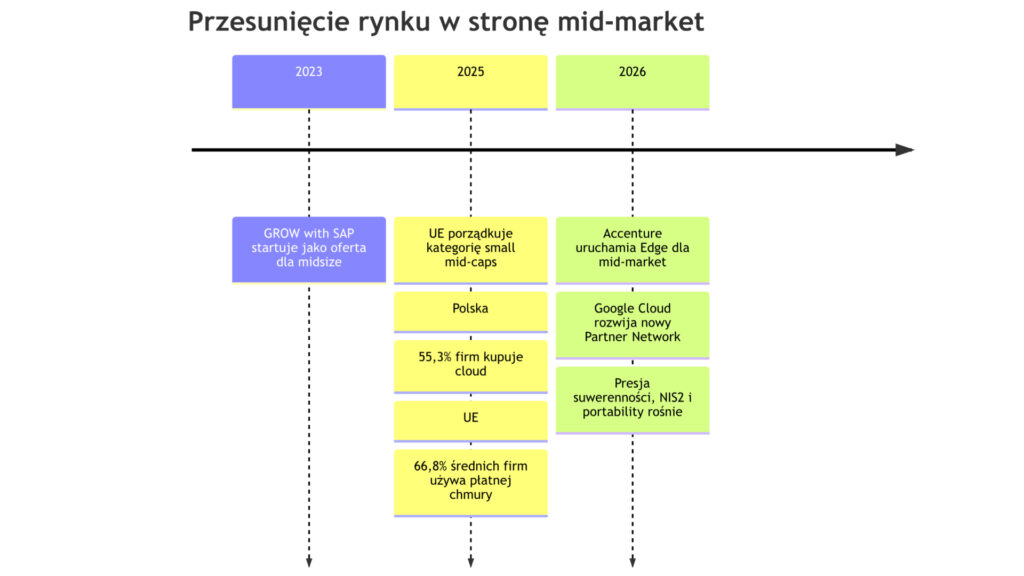
The latest market signals show that suppliers are beginning to understand this. According to the Economic Times, major IT services firms, including Accenture, are creating separate units, operational models and offerings for the mid-market segment. Their proposals focus on the cloud, cybersecurity, system modernisation and AI-related services. This is a significant shift, as it shows that medium-sized companies are no longer merely an add-on to enterprise strategies. They are becoming a separate growth segment.
The reason is simple: the market amongst the largest corporations is already heavily saturated. Every major bank, telecoms operator, industrial conglomerate or retail chain has relationships with Microsoft, AWS, Google Cloud, SAP, Oracle, Salesforce, Cisco, Dell, HPE or global system integrators. The contracts are large, but the sales cycle is long, competition is fierce, and each subsequent growth step becomes increasingly expensive. Meanwhile, there are numerous medium-sized companies, often under-invested in technology and under increasing pressure from customers, regulations and operating costs. For vendors, this is a more challenging market than it appears, but one that is too large to continue to approach indirectly.
This is particularly evident in the cloud. Global spending on cloud infrastructure rose to nearly $400 billion in 2025, and in the fourth quarter alone reached $110.9 billion, up 29 per cent year-on-year. According to Omdia, spending on cloud infrastructure could exceed $500 billion in 2026. This is no longer just a market for migrating servers to the cloud. It is a market for platforms, data, security, productivity tools, business applications and increasingly complex hybrid environments.
For medium-sized companies, however, this means something different from what it does for large corporations. A large organisation can build its own cloud centre of excellence, negotiate framework agreements, employ architects and optimise costs over a multi-year horizon. A medium-sized company often simply wants to know how much it will pay, who will manage the environment, how to avoid vendor lock-in, and whether the migration will bring business to a standstill. That is why, in the mid-market, it is not technology alone that wins the day. What wins out is simplicity, predictability and the ability to demonstrate results without a multi-year transformation programme.
The same is true in cybersecurity. Advania’s ‘Building Core Resilience 2025’ survey, conducted amongst 1,236 IT decision-makers in Northern Europe, reveals growing mistrust of external providers amongst mid-market companies. In the UK, 65 per cent of mid-market organisations state that they manage cybersecurity in-house. At the same time, 40 per cent of respondents believe that vendors prioritise enterprise clients, whilst only 11 per cent say that suppliers act in their best interests.
This is one of the most significant paradoxes of this market. IT giants see mid-market companies as a new growth segment, but mid-market companies themselves increasingly feel that for years they have been treated as second-class customers. They were offered either overly complex enterprise solutions or overly simplified products from the SMB market. Less often did they receive a model truly tailored to their scale, risks and constraints.
Advania’s data also shows that the problems faced by medium-sized companies are not exclusively technological. 57 per cent of respondents cite internal barriers, such as staff turnover, skills gaps and strategic misalignment, as the biggest obstacles to cyber resilience. Among budgetary pressures, the most frequently cited are rising software licence costs, mentioned by 53 per cent of companies; additional cloud services, cited by 43 per cent; and the maintenance of old or end-of-life products, cited by 42 per cent. This is a very specific diagnosis: medium-sized companies do not merely purchase technology. They are simultaneously funding modernisation and paying off their technological debt.
This technological debt is crucial. In many medium-sized companies, the digital core was built up in stages: an ERP system implemented years ago, a CRM system added later, a few industry-specific applications, local integrations, a bit of the cloud, a bit of on-premises infrastructure, backups done ‘good enough’, and security only expanded following incidents or client audits. This landscape worked for years because the business grew despite the technological heterogeneity. Now it is beginning to work against the company. Every new initiative requires integration, data organisation, additional security measures and decisions that were previously put on hold.
That is why vendors are shifting their offerings towards managed services, industry-specific packages, hybrid cloud, simpler ERP implementations and cybersecurity as a service. Microsoft, AWS and Google Cloud aim to be the platforms on which medium-sized companies will build the next layer of digital processes. SAP and Oracle are pushing for ERP migration to the cloud, as they know that legacy transactional systems are increasingly hindering modernisation. Salesforce aims to present CRM not merely as a contact database, but as a system for sales, marketing and customer service. Cisco, Dell and HPE see opportunities in infrastructure modernisation, edge computing, security and ‘as-a-service’ models. Integrators and service providers, in turn, are attempting to act as intermediaries between global technology and local, resource-constrained businesses.
It is no coincidence that Gartner forecasts global IT spending to rise to over $6 trillion by 2026. Spending on data centres, software, IT services and cloud infrastructure is on the rise. But this growth does not mean that every company will find it easier to spend. On the contrary, for many medium-sized enterprises, technology is becoming increasingly expensive and difficult to control. The cloud was supposed to lower the barrier to entry, but on a large scale it can generate costs that are difficult to predict. Subscriptions were intended to simplify purchasing, but with a large number of tools, they put pressure on the budget. Cybersecurity was meant to protect against incidents, but is increasingly a prerequisite for insurance, contracts or participation in the supply chain.
This creates new expectations of suppliers. Medium-sized companies no longer want to buy yet more tools simply because they are ‘modern’. They want to buy the outcome: shorter customer service times, lower risk of downtime, better cost control, more efficient sales, more secure data, simpler reporting and faster operational work. A vendor who approaches them talking only about features and licences will lose out to one who can discuss processes and outcomes.
In Poland, this topic is particularly important, though more difficult to describe using hard data, as the medium-sized enterprise segment is less frequently analysed separately from SMEs in the broader sense. It is well known, however, that the Polish economy relies heavily on companies that are too large to operate as local businesses, yet still too small to have the resources of a corporation. These include exporters, component manufacturers, logistics firms, distributors, system integrators, retail chains, service providers and professionalised family businesses. Many of them already face pressures relating to scale, reporting, cybersecurity and integration with larger business partners. However, their IT architecture is not always ready for the next five years.
For global suppliers, Poland and the CEE region may be attractive precisely for this reason. It is a market of companies that have ambitions for growth, operate within international supply chains and, increasingly, must meet the digital standards imposed by larger partners. But it is also a price-sensitive market, wary of long-term contracts and often reluctant to embrace projects that sound like transformation for transformation’s sake. That is why local partners will be more important here than global presentations. It is they who will translate the cloud, cyber security, ERP and automation into the language of a specific company, its budget and its risk profile.
The biggest mistake IT giants could make would be to treat medium-sized companies as scaled-down enterprises. These are not organisations that need less of the same technology. They need a differently designed offering. Less complexity. Fewer hidden costs. Fewer grand promises. More ready-made scenarios, transparent billing, integration with existing systems and accountability for the outcome of implementation.
The battle for the mid-market will therefore not merely be a battle for licence sales. It will be a battle to become the trusted driver of digital transformation in companies that are too large to improvise and too small to enjoy corporate comforts. This could be the most interesting segment of the IT market in the coming years, as it brings together all the tensions of the digital economy: pressure for growth, a skills gap, cyber risk, cloud costs, ageing systems and the need for a rapid return on investment.
Medium-sized companies are no longer merely the backwater of the technology market. They are becoming its testing ground. If the IT giants can simplify technology without dumbing it down, they can unlock one of the most important new streams of growth. If not, the mid-market will remain a source of frustration: too big to ignore, and too demanding to serve using the old sales model.