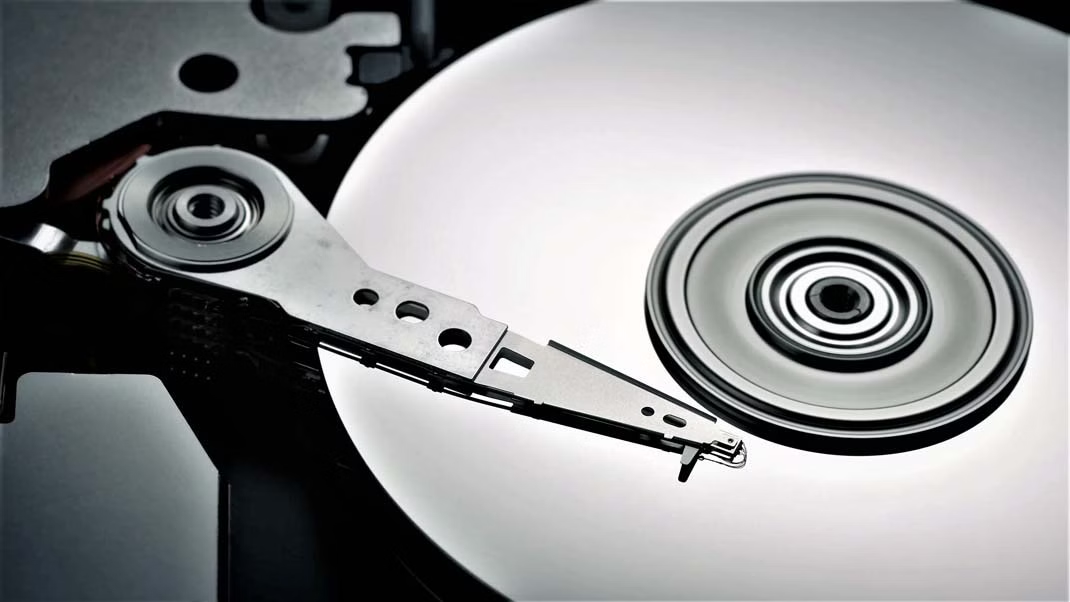
Seagate’ s latest lab achievement could change the trajectory of the storage market faster than expected. Achieving storage densities capable of fitting 6.9TB of data on a single platter is technical proof that it is feasible to build drives of nearly 70TB in the standard 3.5-inch format. Given that today’s enterprise-class drives can accommodate up to ten such platters, the vision of a capacity leap becomes tangible.
For data centre operators and cloud service providers, where every inch of rack space has a measurable financial value, this is a key signal. In this segment, the game is about maximising data density, which directly translates into lower total cost of ownership (TCO). The foundation for this success is the Mozaic 3+ platform, a market implementation of HAMR technology. Although the brand’s current flagship, the Exos 32TB model, already benefits from advanced laser-assisted magnetic recording, laboratory results confirm that the technology still has a huge amount of scalability.
Previous announcements of 50TB or 100TB drives have been treated with some reserve by the industry. However, a result close to 7TB per platter shows that Seagate ‘s ambitious schedules are based on hard physics and not just marketing. While we will still have to wait for the market release of finished 69TB units, the successful scaling of HAMR suggests that entering the era of 100-terabyte drives is already just a matter of optimising manufacturing processes rather than a distant theory.