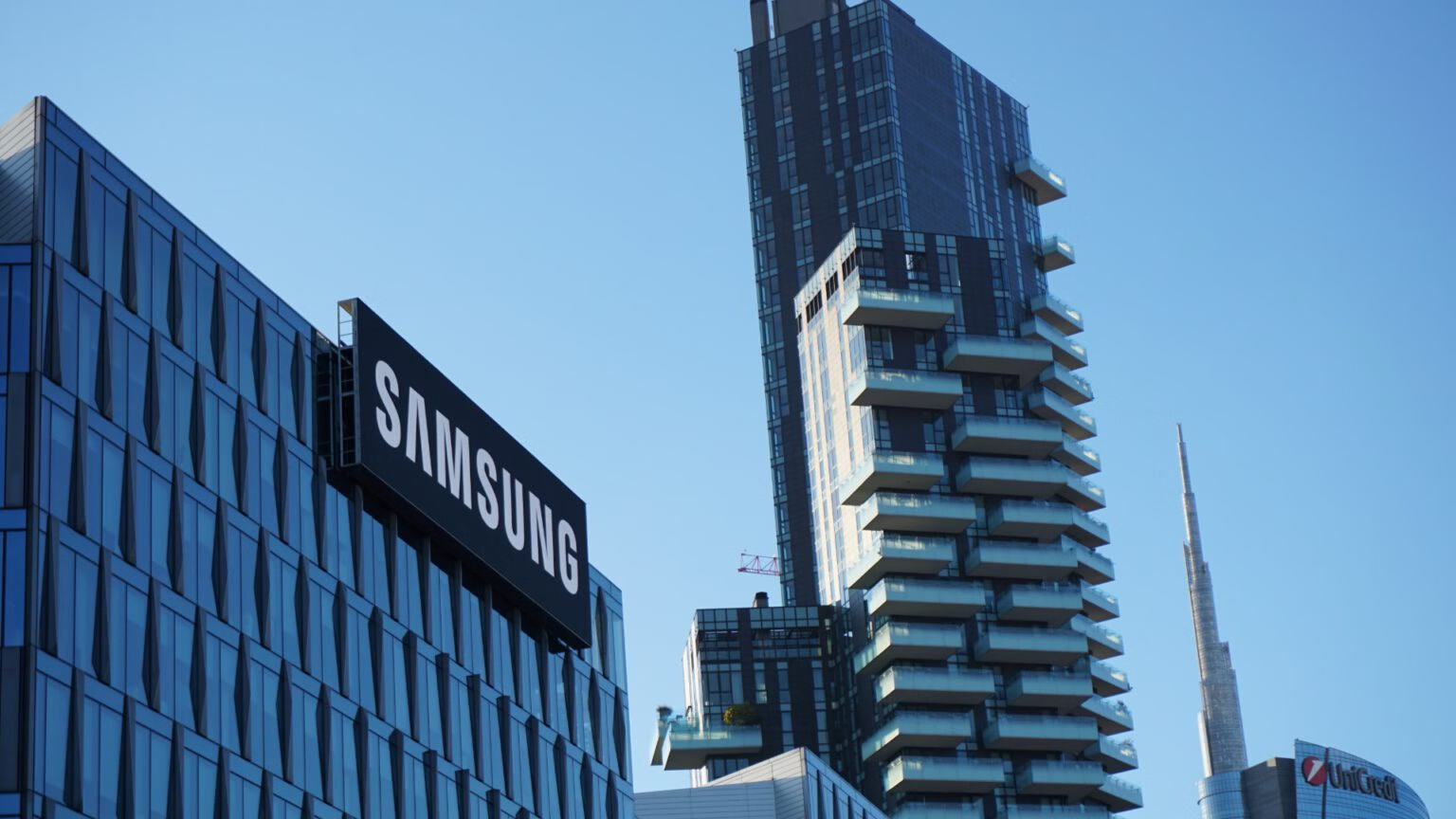
South Korea has announced a package of artificial intelligence initiatives with a declared value of $950 billion. Samsung Electronics and SK Group are set to play a key role, whilst on the US side, Nvidia and Broadcom will be involved. The scale of the investment is impressive, but it does not represent a one-off expenditure. Some of the agreements take the form of letters of intent and cover long-term supplies, technology development and infrastructure construction.
The largest project is the collaboration between SK Group and Nvidia, valued at over $500 billion. It covers the development of HBM memory, essential for advanced AI systems, and a data centre with a capacity of up to 2 GW. The first phase of the infrastructure is due to be launched in 2027. Samsung, meanwhile, has signed a memorandum of understanding with Broadcom concerning memory, 2 nm chip manufacturing and advanced packaging. The value of the collaboration up to 2030 has been estimated at over $200 billion.
For Seoul, this is not only a technological project but also part of its industrial policy. South Korea aims to leverage its strong position in memory production to capture a larger share of the value generated by the global AI boom. This is being facilitated by a favourable export climate. In the first half of 2026, South Korean semiconductor exports rose by 163 per cent year-on-year.
However, the investments will be carried out against a backdrop of more expensive financing. In July, the Bank of Korea raised its key interest rate to 2.75 per cent, citing higher inflation and rising household debt.
Competition in AI is increasingly less about the models themselves and more about access to chips, energy and data centres. South Korea could become one of the main hubs for this infrastructure. Risks remain, however, in the form of huge costs, dependence on a few major clients, and the possibility of oversupply should the pace of investment in AI slow down.