Few companies have caused such a big stir in such a short space of time as Anthropic. Founded in 2021, the company has grown from a niche research lab to a massive technology conglomerate with a valuation of up to $900 billion. In April 2026, Anthropic reached a staggering annualised revenue run-rate of $30 billion , overtaking OpenAI in terms of corporate market penetration.
Anthropic – origins and unique corporate structure
The formation of Anthropic in 2021 was a direct result of a deep split within OpenAI. Siblings Dario Amodei (then vice-president of research at OpenAI) and Daniela Amodei (vice-president of security and policy), along with a group of nine leading engineers and scientists, left the company in protest at its progressive commercialisation. The bone of contention was, among other things, that the GPT-3 model was released too quickly without proper, scientifically validated safeguards against disinformation.
Wanting to avoid market pressures for immediate profit at the expense of ethics, the Amodei siblings designed a unique legal and organisational architecture for the company:
- Public Benefit Corporation (PBC): Anthropic operates as a public benefit corporation. This means that its board of directors has a legal obligation to treat the welfare and safety of AI as equal to maximising profits for shareholders.
- Long-Term Benefit Trust (LTBT): To secure this mission, an independent trust has been established, comprising prominent national security and public health experts independent of financial performance (including Neil Buddy Shah, Mariano-Florentino Cuéllar and Richard Fontaine). The Trust controls special Class T shares, giving the trustees the right to progressively appoint and remove members of Anthropic’s board of directors.
Technological paradigm: Constitutional AI and RLAIF
Anthropic’s main technological differentiator from its competitors is a machine learning method called Constitutional AI (CAI).
Traditional model learning is based on the Reinforcement Learning from Human Feedback (RLHF) method, the work of thousands of people manually assessing the model’s statements for harmfulness. However, RLHF is a slow, expensive process and prone to transferring the subjective biases of human interviewers to the final weights of the network.
Anthropic has replaced this mechanism with RLAIF (Reinforcement Learning from AI Feedback) technology. In this approach, the training process is based on a loop of self-criticism and self-correction, in which one model evaluates and corrects the responses of another based on a shisan set of rules – the so-called Constitution. This Constitution, which contains rules based on the UN Declaration of Human Rights and internal ethical standards, has grown from 2,700 words in 2023 to more than 23,000 words in 2026. The result of this process is models demonstrating assertiveness and logical argumentation instead of evasive, mechanical refusals.
Product ecosystem and Claude 4 family
Anthropic’s portfolio is based on a three-part model naming to suit different business needs: the fastest and cheapest Haiku, the balanced Sonnet and the flagship, most advanced Opus.
In May 2025, the company launched Claude Generation 4, designed for the era of agent-based systems. Now in mid-2026, the key tools in Anthropic’s portfolio are:
- Claude Opus 4.7 (Release: 16 April 2026): The most powerful model on the market, outclassing the competition in software engineering and scientific inference testing.
- Claude Code: a console agent tool (CLI) designed for self-programming, bug-finding and code compilation. The tool sparked a wave of popularity for so-called ‘vibe coding’ in 2025/2026 and now generates more than $2.5 billion in revenue annually.
- Computer Use: A feature that allows Claude models to visually analyse the computer screen in real time and autonomously control the mouse and keyboard to automate complex office tasks.
- Agent Teams: Ability to create and orchestrate collaborative sub-agents within the .claude/agents directory.
- Claude Mythos (April 2026): A specialised, limited-edition model dedicated to advanced zero-day vulnerability detection in cyber security.
| Model | Release date | Context window (Tokens) | Operational status | Key Innovations and Characteristics |
|---|---|---|---|---|
| Claude 1 | March 2023 | 9 000 | Withdrawn | First commercial implementation of Constitutional AI, made available to a small group of testers. |
| Claude 2 | July 2023 | 100 000 | Withdrawn | The first model made available to the public; revolutionary for the time, processing entire documents in a single query. |
| Claude 2.1 | November 2023 | 200 000 | Withdrawn | Double the context window, reducing hallucinations by 50%. |
| Claude 3 (Haiku/Sonnet/Opus) | March 2024 | 200 000 | Withdrawn | Introduction of triadic naming; native multimodality (image analysis); high context awareness. |
| Claude 3.5 Sonnet | June 2024 | 200 000 | Withdrawn | Premiere of Artifacts feature allowing interaction with code in a dedicated window; outclassing competitor models in engineering tasks. |
| Claude 3.5 Haiku | October 2024 | 200 000 | Withdrawn | Significant acceleration of reaction time while maintaining high logical reasoning abilities. |
| Claude 3.7 Sonnet | February 2025 | 200 000 | Withdrawn | The first hybrid reasoning model with a user-controlled extended thinking mode. |
| Claude Sonnet 4 / Opus 4 | May 2025 | 1 000 000 | Withdrawn | Generation four officially launched; native integration with the Claude Code agent tool. |
| Claude Opus 4.1 | August 2025 | 1 000 000 | Active | Implementation of proactive security filters; ability to break sessions deemed permanently toxic or illegal. |
| Claude Sonnet 4.5 | September 2025 | 1 000 000 | Active | Balanced corporate model with high-precision data structuring. |
| Claude Haiku 4.5 | October 2025 | 200 000 | Active | A high-speed, low-latency computing unit dedicated to massive cloud and mobile deployments. |
| Claude Opus 4.5 | November 2025 | 1 000 000 | Active | Premiere of Infinite Chats feature eliminating memory overflow errors; dominance in mathematical tasks. |
| Claude Opus 4.6 / Sonnet 4.6 | February 2026 | 1 000 000 | Active | Native support for the orchestration of agent teams(Agent Teams) collaborating within the .claude/agents catalogue. |
| Claude Mythos (Preview) | April 2026 | Over 1 000 000 | Limited Availability | Highly specialised model dedicated to cyber security tasks and offensive detection of zero-day vulnerabilities. |
| Claude Opus 4.7 | April 2026 | 1 000 000 | Active (Flagship version) | The most logically advanced model on the market; implementing financial tokenbudgets per task(task budgets). |
SWOT analysis for corporate implementations
The decision to implement Claude models in an enterprise IT architecture brings with it concrete gains and challenges.
Advantages (Strengths)
- Unrivalled programming ability: Claude Opus 4.7 achieves a record 87.6% in the SWE-bench Verified test and 64.3% in the more difficult SWE-bench Pro test (compared to 57.7% of the competing GPT-5.4).
- Excellent tool integration: with a score of 77.3% in the MCP-Atlas test, Claude models flawlessly coordinate queries to databases and external APIs using the Model Context Protocol (MCP).
- Extensive context window: These models support an input context of up to 1 million tokens and can generate up to 128,000 output tokens in a single response, enabling the analysis and creation of entire systems or extensive financial reports.
Minuses (Weaknesses and cost risks)
- High cost of operation: Claude Opus 4.7 costs $5 per million input tokens and as much as $25 per million output tokens. By comparison, the competing Google Gemini 3.1 Pro costs $2 and $12 respectively.
- Risk of cost loops: Autonomous agents can generate huge costs with long, looping tasks. To this end, the company has introduced a budget limits function (task budgets).
The dark side of success: The biggest controversies and crises
Anthropic’s rapid growth has led to the disclosure of several critical business and legal vulnerabilities:
- Settlement in the Bartz v. Anthropic trial (August 2025)
Anthropic has paid a record $1.5 billion in a class action lawsuit representing the interests of nearly half a million authors. Although Judge William Alsup ruled that training AI on legal materials was a permitted use (fair use), downloading and storing pirated book databases (LibGen and PiLiMi) in the company’s ‘central library’ was an infringement. Anthropic had to destroy the illegally acquired files and compensate the authors with approximately $3,100 per work. In May 2026, some authors who rejected the terms of the settlement (including Dave Eggers) filed a new lawsuit.
- The war with the Pentagon over the militarisation of AI
At the end of 2025, a fierce dispute erupted over the ethical limits of the use of Claude models. The Pentagon demanded the removal of filters blocking the models’ use in autonomous weapons systems and for mass surveillance of US citizens. When Anthropic refused, Secretary of War Pete Hegseth declared the company a “threat to the supply chain” under 10 U.S.C. § 3252, terminating contracts and prohibiting military subcontractors from working with Anthropic. Despite Anthropic’s initial court victory in March 2026 , in April an appeals court upheld the Pentagon’s decision on national security grounds, generating enormous legal uncertainty for the company’s business partners.
Hyper-scaling and computational alliances
The rapid growth in demand for Anthropic’s services triggered a critical compute crisis. The company managed to temporarily contain it thanks to a series of spectacular infrastructure deals :
- SpaceX (May 2026): Leased 100% of the Colossus 1 supercomputer cluster in Memphis (over 220,000 Nvidia H100/H200/GB200 GPUs, 300 MW of power). This immediately doubled the operational limits for Claude Code users.
- Amazon AWS: $25 billion investment and securing 5 GW of Trainium chip-based power.
- Google & Broadcom: Agreement guaranteeing 5 GW of power (based on Google TPU processors) from 2027.
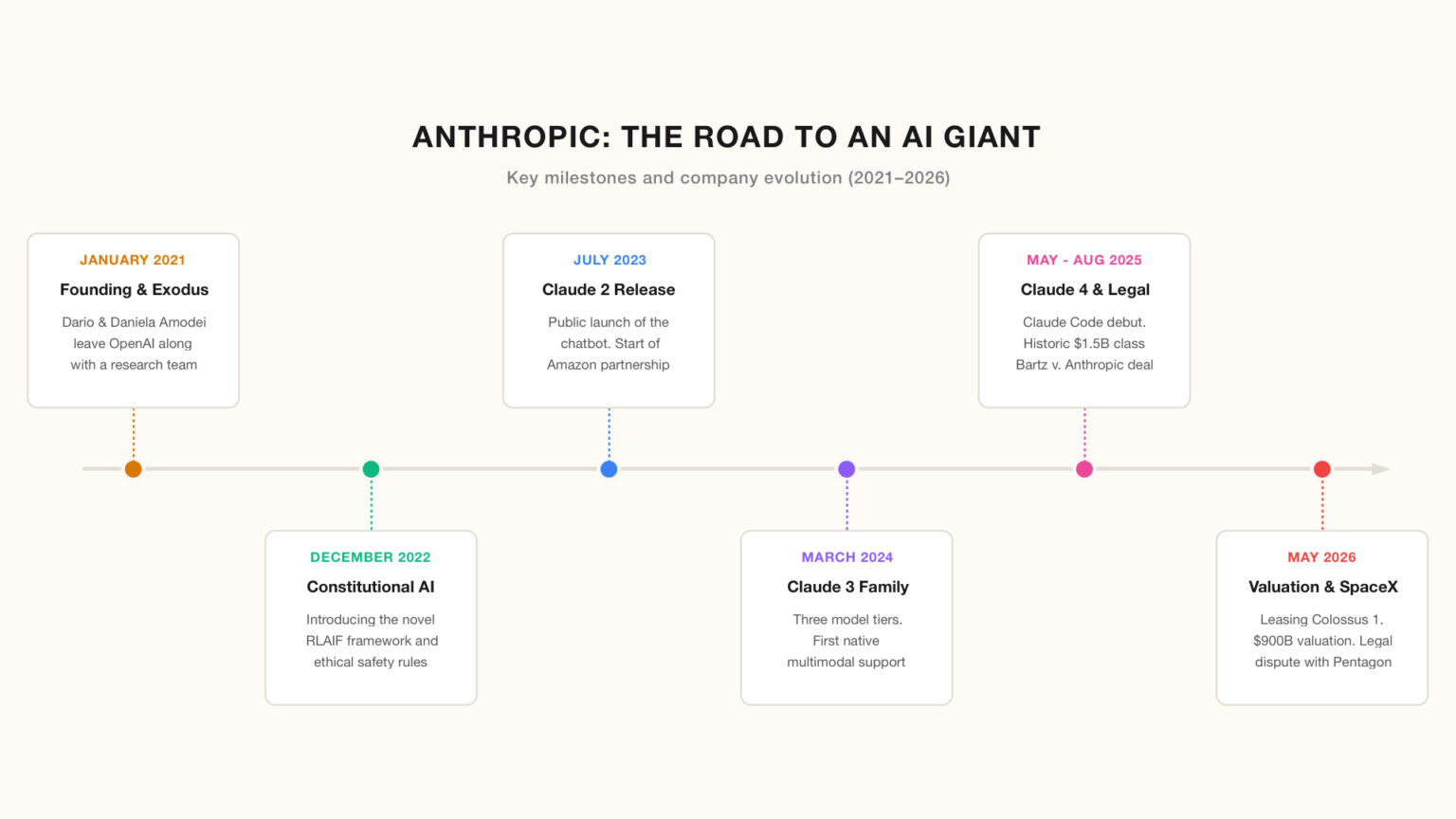
Timeline: Anthropic’s evolution (2021-2026)
Founded in 2021 by former OpenAI leaders, Anthropic began with revolutionary research into the security of AI systems, resulting in the publication of the Constitutional AI concept in late 2022. The following years saw rapid market expansion and the release of public versions of the Claude family of models, supported by multi-billion dollar infrastructure investments from giants such as Amazon and Google. By 2026, the company reached a valuation of $900 billion and a leadership position in the agent era thanks to the mass adoption of the Claude Code tool, the launch of the flagship Opus 4.7 model and the strategic lease of the Colossus 1 supercomputer from SpaceX.
Anthropic – a phenomenon, covered in dust?
The Anthropic phenomenon lies in a fascinating but profound ethical paradox. Founded by the Amodei siblings as a ‘safe and moral’ alternative to the commercialised OpenAI, the company faced the brutal reality of a ruthless technology race in 2026. Achieving a valuation of $900 billion and an annual revenue ratio in excess of $30 billion, it proved that there was no room for romantic idealism in the world of frontier models. In order to survive and win, Anthropic had to start playing by the same brutal market rules it once ran from.
The best evidence of this pragmatic transformation is, on the one hand, the record settlement in Bartz v. Anthropic for $1.5 billion for illegally training models on pirated databases , and on the other hand, the spectacular agreement with SpaceX for the lease of the Colossus 1 supercomputer. The agreement with Elon Musk’s entity, which has previously publicly attacked Anthropic on several occasions, shows that the gigantic hunger for computing power is stronger than personal or ideological animosities.
At the same time, the hard clash with the Pentagon on the issue of autonomous lethal weapons and mass surveillance shows the limits of this compromise. The decision to defend its ethical ‘red lines’, which resulted in the government administration’s retaliatory listing of the company as a threat to national security , is a rare act of corporate assertiveness in modern business. Nevertheless, this geopolitical paralysis calls into question the company’s operational stability in the public market.
Anthropic is no longer just the ‘conscience of Silicon Valley’ – it is a powerful, pragmatic corporate conglomerate. Their history shows that the development of artificial intelligence requires monstrous resources, and that maintaining an impeccable ethical record on the road to AGI is becoming a luxury that even the most moral players cannot fully afford.