Driven by the unprecedented development of artificial intelligence, today’s digital economy seems to be operating in a kind of paradox. On the one hand, the world delights in the intangible nature of algorithms, the lightness of cloud computing and the finesse of generative models that redefine the concept of productivity. On the other hand, however, this digital superstructure is set on an extremely heavy physical foundation: energy infrastructure. Artificial intelligence, hailed as the new electricity of our time, paradoxically exhibits an insatiable hunger for this traditional, socket-flowing energy. In a public debate dominated by considerations of code ethics or data security, too little attention is paid to the fundamental question: where will the electricity necessary to power this revolution come from, so that the process is stable, clean and strategically secure.
Data from reports by the International Energy Agency leave no illusions about the scale of the challenge. It is estimated that the global energy consumption of data centres could double as early as 2030 as a direct consequence of the expansion of cloud computing and the training of increasingly complex language models. However, this is just the tip of the iceberg, underneath which lies the massive digitalisation of the entire industrial, transport and residential sectors. Projections indicate that by 2035, data centres alone will require an additional 1,000 terawatt hours, but the needs of the rest of the economy will increase by nearly six times this figure. Global energy demand, according to analysis by Rystad Energy, is expected to increase by almost a third in just a decade. In this context, the traditional approach to the energy transition, based solely on classic renewables, is showing its limitations.
The business and technology sector is facing the need to redefine the concept of operational stability. Indeed, digital security is inextricably linked to the security of power supply, and this requires a source that is not only environmentally friendly, but above all controllable and independent of the vagaries of the weather or geopolitical turmoil.
This is where fusion energy comes onto the scene, which has undergone a fascinating transformation in recent years from the domain of science fiction literature to the realm of hard business strategy. Major players in the global technology market, such as Microsoft, Google and Amazon, have long since abandoned their role as passive observers and become active investors in fusion projects. Cumulative funding in private fusion companies has risen to €13 billion by 2025, an eightfold increase from the beginning of the decade. The involvement of IT leaders is not driven by philanthropic motives, but by a pragmatic risk assessment. Having a stake in a technology that generates almost unlimited and pure power is an insurance policy for further innovation.
However, the current investment landscape reveals a worrying asymmetry for Europe. The US accounts for more than half of global fusion investment, treating the technology as an element of national security and competitive advantage. The US government’s change of stance at the end of 2025, making fusion a strategic priority, clearly defines the rules of the new game. Right behind America is China, pumping huge state resources into building its own energy ecosystem. Such a bipolar panorama should be an alarm bell for European decision-makers. The continent cannot afford to repeat the mistake made in the semiconductor sector or in artificial intelligence itself, where marginalisation has led to deep dependence on external suppliers and technologies.
What about Europe?
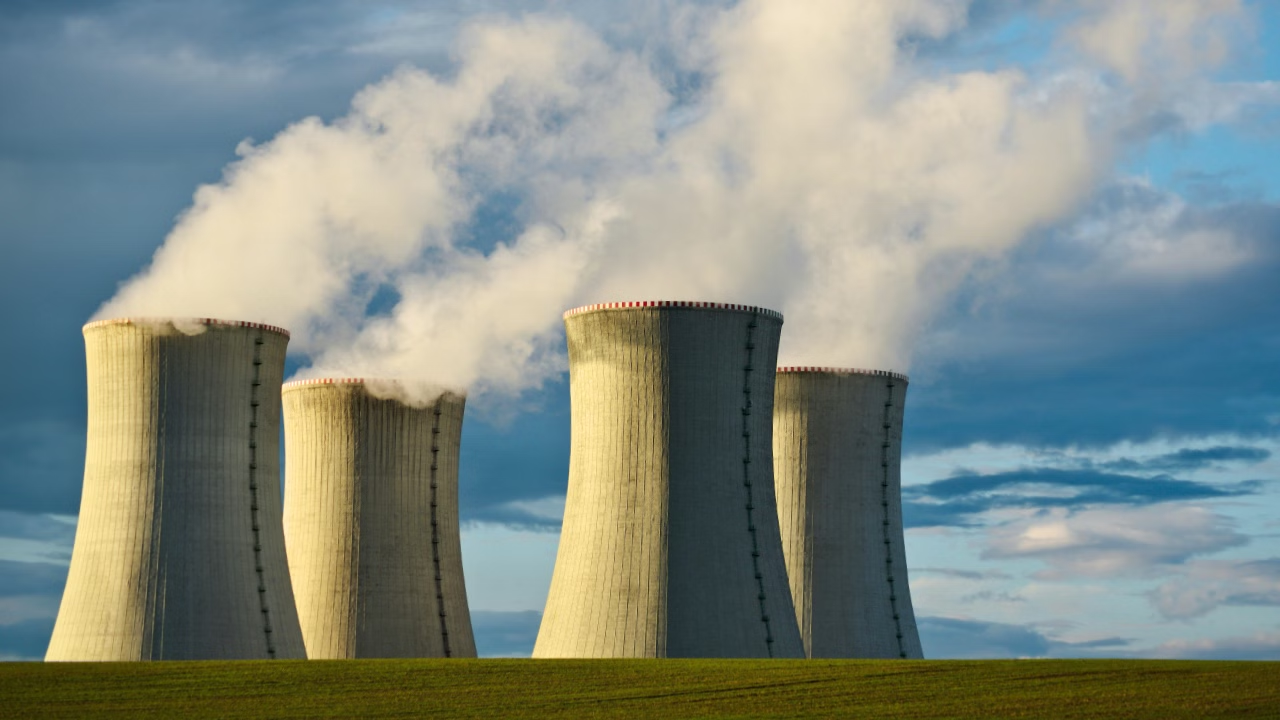
With the demand for computing power growing exponentially, building a sovereign and inexhaustible source of power is becoming an absolute requirement for maintaining the competitiveness of the modern economy. This paradigm shift, although seen in the silicon valleys of the world, took on particular political weight at the recent Nuclear Energy Summit in Paris. It was there that the President of the European Commission, Ursula von der Leyen, uttered words that, to many, sound like a belated but necessary thumping of the chest: Europe’s turn away from the atom was a strategic mistake, and the figures describing this regression speak for themselves.
Acknowledging that the systematic extinguishment of the nuclear sector on the Old Continent – a decline in its share from a third in 1990 to just fifteen per cent today – was a geopolitical blunder directs attention to the challenges facing the technology sector. Today’s digital economy, fascinated by the lightness of artificial intelligence algorithms, is in violent collision with the physical reality of transmission networks. Often referred to as an immaterial revolution, artificial intelligence displays an insatiable hunger for stable, clean and cheap energy. In this context, Europe’s dependence on unstable fossil fuel imports is becoming not only an economic ballast but, above all, a development barrier that could relegate the continent to the role of a technological open-air museum.
Poland’s situation in this new deal appears particularly dramatic and requires immediate strategic reflection. While the leaders of the European Union are beating their chests and drawing up plans for a return to nuclear power, the Polish energy landscape remains afflicted by the historic lack of even a single operational nuclear power plant. This structural shortage, at a time of expansion of generative models and data processing centres, ceases to be merely a matter of energy security and becomes a considerable problem for the Polish IT sector. Ambitions to build an innovation hub on the Vistula and develop indigenous artificial intelligence systems may be effectively stifled by the lack of a foundation of stable network base load.
Investors planning to build large-scale data centres are guided by pragmatism, in which the availability of low-carbon and uninterruptible energy plays a key role. Poland, basing its energy mix on declining coal and rapidly growing but weather-dependent renewables, without a ‘nuclear stabiliser’ becomes a location with high operational risk. Not only does the absence of nuclear mean higher emission costs affecting the margins of technology companies, but above all the lack of a guarantee of power continuity, without which advanced training of AI models is simply impossible. As a result, the most valuable digital projects may bypass Polish soil, choosing countries that have been able to turn nuclear pragmatism into a competitive advantage.
The clear change of course in Brussels, emphasising the role of small modular reactors and nuclear fusion, should be a signal for Polish business to mobilise. Since the European Union intends to allocate billions of euros to fusion research as part of the ITER project and to create guarantees for private investment in a new generation of nuclear technologies, Poland cannot afford to be a passive observer. It is necessary to create mechanisms that will allow Polish technology companies to actively participate in building a value chain for the nuclear sector. Fusion, although still seen as the horizon of the future, is today the only real answer to the energy blackmail facing the digital world.
The geopolitical race for control of the earth’s ‘artificial sun’ is gathering pace. The United States, considering the development of fusion technology as a matter of national security, and China, heavily funding state nuclear projects, have created a bipolar power structure. Europe, if it does not want to become a mere client of these powers, must develop its own model of cooperation – a kind of ‘Eurofighter of Energy’. This comparison to a European fighter is not coincidental; building a modern fusion-based energy system requires an analogous scale of industrial, scientific and financial coordination. For Poland, participation in this endeavour is a chance to leapfrog several stages of technological backwardness and enter directly into the elite of tomorrow’s energy management countries.
It is worth noting that nuclear fusion offers more than just electricity – it offers sovereignty. When defence systems, critical infrastructure and everyday communications are based on artificial intelligence, any interruption in energy supply becomes an attack vector. A stable, indigenous source of power, located close to decision-making and technology centres, is the best shield against external pressures. What this means for Polish business is that more pressure needs to be exerted to accelerate nuclear projects, not only in the traditional sense, but especially in the area of innovative SMR and fusion technologies that can be implemented closer to the industrial consumer.
The diagnosis made by Ursula von der Leyen is painful but invigorating for the European debate. Europe, and Poland in particular, must reject preconceptions in favour of engineering realism. Artificial intelligence will not wait for energy systems to keep up with its needs; it will simply move to where energy is abundant, cheap and clean. Poland, facing the historic challenge of building its first reactor, must understand that this is not a building project, but the foundation of a future digital power. Without the atom, the dream of Polish artificial intelligence will remain just a beautiful code written on servers that will be impossible to run. It is time for an honest analysis of the numbers and strategic shortcomings to become the impetus for building the energy sovereignty that will allow innovation to fully flourish on our soil.