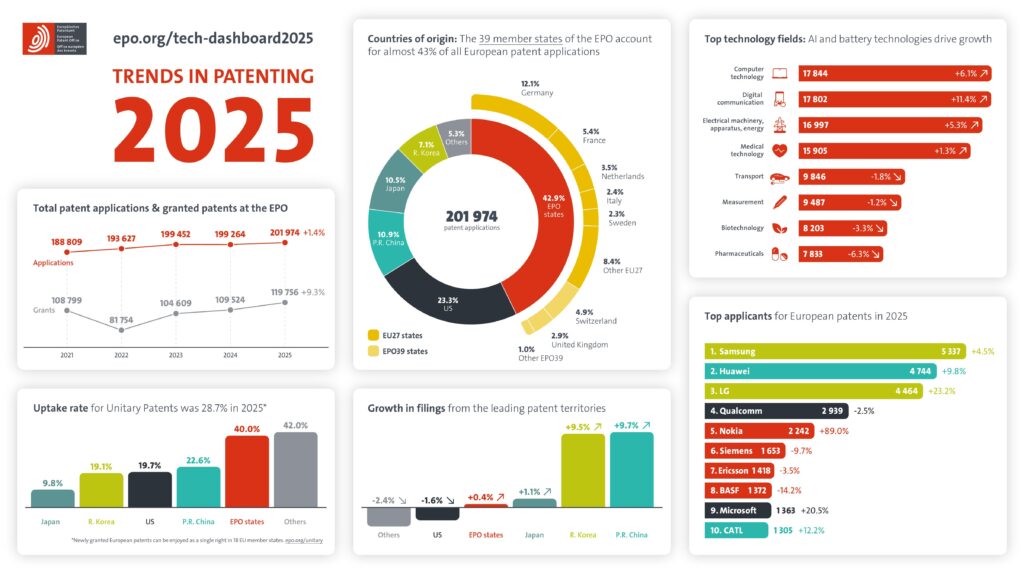
The latest data from the EPO Technology Dashboard 2025 report brings a bittersweet picture of the Polish innovation ecosystem. Although the number of patent applications to the European Patent Office (EPO) fell by 10.3% year-on-year, Polish inventors shifted their focus towards high value-added sectors such as pharmaceuticals and biotechnology. With 621 applications, Poland maintains its 12th position in the European Union, remaining the undisputed innovation leader in the CEE region.
Turning from quantity to strategic quality
The decline in dynamics after a period of intense growth lasting from 2021 can be interpreted as a market correction, but the long-term outlook remains optimistic. Compared to 2016, the number of Polish applications increased by 58%, twice the average dynamics of the EPO as a whole (27%).
What is most interesting about this year’s list is the changing of the guard in key sectors. The previous leader, medical technology, gave way to pharma, which recorded a spectacular 51.7% year-on-year growth. Strong growth was also recorded in transport and automotive, as well as machinery and energy, which directly correlates with the global race for renewables and battery technology.
Academic innovation engine
A peculiarity of the Polish market, which distinguishes it from Western economies, is the dominant role of the public sector and science. While globally the EPO rankings are dominated by technology giants, in Poland half of the leading applicants are universities and research institutes. Jagiellonian University, the Medical University of Gdansk and the University of Warsaw remain the main drivers of domestic intellectual property.
From a business perspective, this raises the question of the effectiveness of technology transfer from the walls of academia to industry. However, the record interest in the Single European Patent** suggests that Polish innovators are thinking broadly about commercialisation. As many as 59.6% of patents granted to Poles were granted unitary status, which is significantly higher than the EU average (40.7%) and facilitates expansion into the markets of 18 EU countries.
Human capital and regional bastions
Poland also stands out from Europe in terms of inclusiveness. Every third patent application from the Vistula (35%) mentions a woman as a co-inventor. This result is well above the European average (26%), giving Poland 5th place in the entire EPO.
Geographically, the innovation map remains stable, although there are signs of decentralisation. Warsaw, despite a decline in the number of applications, controls more than a quarter of the market. Malopolska is strengthening behind it, and Lower Silesia is the only one of the leading regions to record an increase in activity (by 8.5%), confirming Wrocław’s status as a growing technology hub.
At a time of a global race in fields such as AI, 6G or quantum technologies, Poland’s breathlessness in 2025 may only be a stopgap before the next leap – if the research momentum of universities can be sustainably translated into market successes for companies.
“The record number of European patent applications underlines our continent’s innovation potential and its attractiveness as a global technology market,” said EPO President António Campinos. “The Technology Dashboard 2025 examines progress as well as gaps in specific industry sectors, helping decision makers in Europe to identify priority areas and guide actions and investments that strengthen technological sovereignty and competitiveness. While the European unitary patent is already removing barriers and accelerating the transition to a more integrated innovation market, the topic still deserves our attention, especially in strategic sectors such as artificial intelligence, semiconductors, health and quantum technologies,” adds the EPO President.