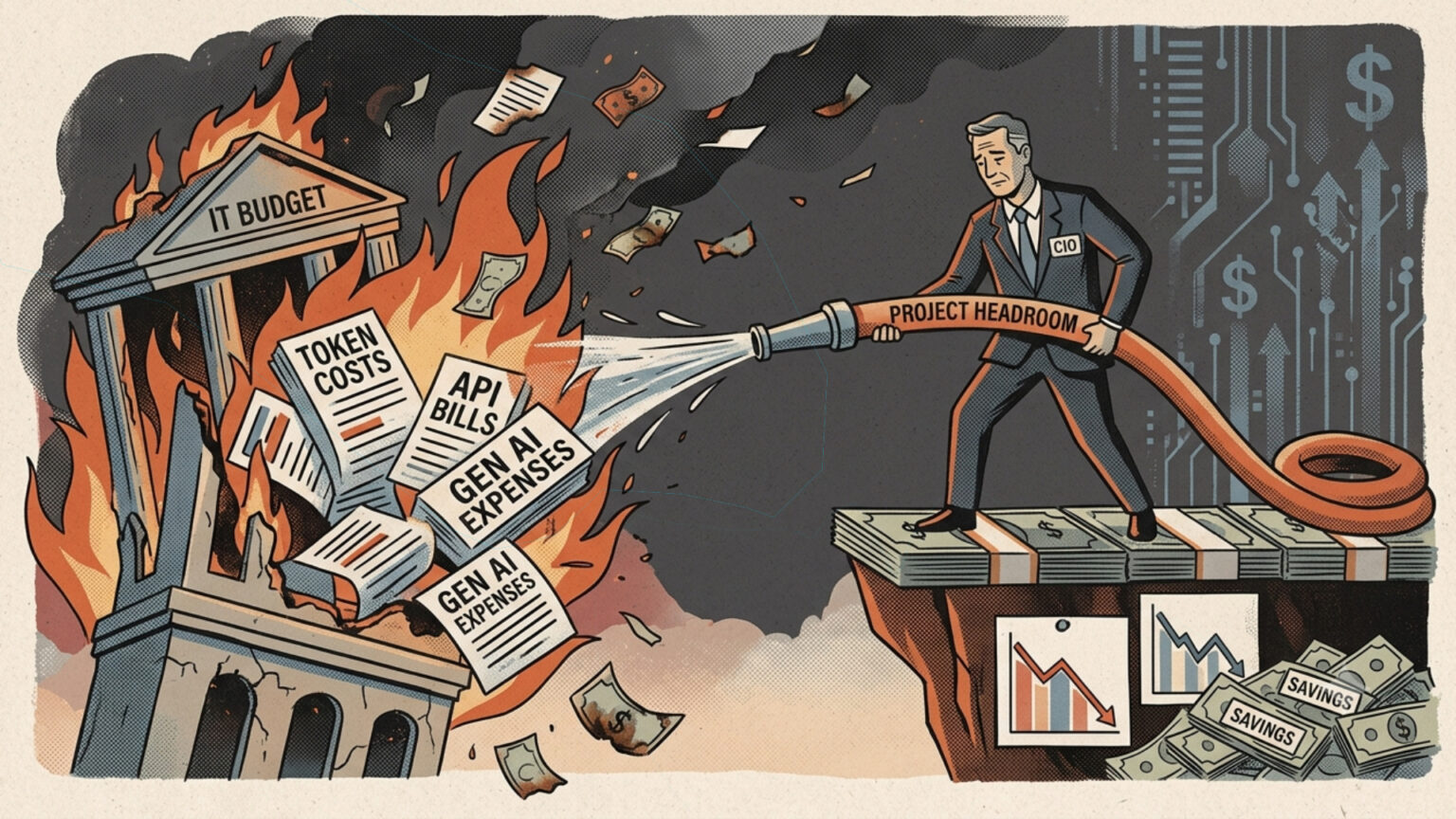
Until recently, the narrative around generative AI was simple: implement, automate, drink the cream of increased efficiency. However, the turn of the year and the first months of 2026 verified this boundless optimism. CFOs and technology leaders were confronted with invoices from language model providers.
The strategic imperative to saturate business processes with autonomous agents and AI assistants led to a phenomenon that, behind the scenes in the industry, is referred to as the token explosion. The operational costs of APIs began to increase exponentially, often completely eating up the profits generated through automation.
In this landscape of financial hangover, however, a solution has emerged that perfectly punctuates the wastefulness of modern AI architecture. It’s Project Headroom – an independent, open-source app that proves that instead of buying bigger data silos, you just need to start sending data with your head.
Anatomy of waste: Where do tokens disappear?
Most managers assume that high API bills are the result of elaborate staff queries or complex prompting algorithms. This is a mistake.
Project Headroom’s creator, Tejas Chopra (by day a senior developer of Netflix’s storage platform), discovered this by accident when analysing his own worryingly high bills for using the Claude Sonnet model on private projects. A detailed inspection of the uploaded data volume yielded a surprising conclusion: human instruction and proper code accounted for a minority of the charges.
The real culprit turned out to be digital ‘noise’, viz:
- Machine-generated metadata,
- Repetitive blocks of configuration text (boilerplate),
- Extremely elaborate and redundant JSON schemas,
- Nested, multiple response templates from other APIs,
- Identical, duplicate database columns.
Research confirms this intuition. More than 76% of total token consumption in enterprise queries goes down to reading system context and user data, rather than generating new value.
The situation is drastically exacerbated by modern standalone development tools such as Claude Code or Cursor. They work in a loop – for every interaction with the user, even the smallest one, they send the entire project context to the model anew. For language models, these structures are readable, but from the point of view of logic and problem understanding – powerfully redundant. They are simply compressible data hidden under the form of plain text.
Filter architecture, or how to cheat the suppliers’ cache
Project Headroom approaches the problem in an elegant and non-invasive way. The tool acts as a local proxy server running directly on the developer’s workstation or on the company’s internal server, intercepting API calls on port 8787. Rather than allowing the application to hit Anthropic or OpenAI servers directly, Headroom runs the data through a two-tier filter architecture.
Level 1: CacheAligner and the fight against memory ‘scrubbing’
Vendors such as OpenAI or Anthropic tempt the markets with large discounts on so-called cached tokens (prompt caching). They want to relieve the burden on their own data centres in this way. The problem is that these mechanisms are extremely sensitive. If even one unique identifier (UUID) or timestamp changes with each session in your system prompt, the provider’s algorithm recognises this as a completely new query (cache miss). The result? The entire giant context is recalculated and billed from scratch, at full price.
CacheAligner detects these microscopic, dynamic changes, stabilises the variable prefixes and ensures that only those fragments that have actually been modified go into the provider’s KV cache.
Level 2: Intelligent router and structured compression
Once the cache is stabilised, the data goes to specialised modules. Headroom is not a simple ‘space cutter’. Among other things, it has an AST (Abstract Syntax Tree) parser that can clean up programming code from elements unnecessary for LLM logic, as well as dedicated modules that remove unused elements from JSON arrays and HTML documents.
Using statistical squash algorithms that learn in a continuous feedback loop, the tool decides which entries from the server or database logs are key to a given question. The results?
- Reduction in the size of server protocols by up to 90%,
- Reduction of JSON files by an average of 70%.
Reversible compression (CCR). Why isn’t this just a ‘Token Killer’?
There are already solutions on the market that attempt to combat contextual sprawl, such as Rust Token Killer (RTK) or LeanCTX. However, they all suffer from the same affliction: they compress data irretrievably. Removing a detail from technical documentation or code can make a language model – devoid of nuance – hallucinate or generate the wrong answer.
Project Headroom circumvents this reef with its proprietary Compress Cache and Retrieve (CCR) concept of reversible compression.
How does CCR work in practice?
By slimming down the text sent to the cloud, the tool leaves unique substitution symbols and tags (anchor tokens) in the text. At the same time, the full, original data is stored locally in a high-speed database (Redis or SQLite) on the developer’s machine.
If the language model, in the course of processing a query, realises that it is missing details hidden under a given placeholder token for an accurate answer, it is able to reach for them itself. It uses the open Model Context Protocol (MCP) to do this. The model ‘asks’ the local Headroom tool to send a specific, uncompressed fragment. Everything happens in real time, locally, without the need to repeat an expensive and slow API request to the provider’s cloud.
Breaking the “Context Red”
Spend optimisation is only one side of the coin. It turns out that feeding models with giant contextual windows degrades their… intelligence.
Research by Stanford University and data integrator Chroma has exposed a phenomenon called context redness. Language models, despite manufacturers’ claims to support hundreds of thousands of tokens, tend to ignore information in the middle of long blocks of text. The more ‘noise’ we cram into a prompt, the less likely AI is to pick out the key information from it.
By shrinking the context window with Project Headroom, we kill two birds with one stone:
- We increase the relevance and quality of AI responses, as the model operates solely on the essence of the data.
- We drastically reduce latency, which is crucial in real-time enterprise systems.
Landscape after the revolution: Time for ‘Lean AI’
Although Project Headroom started as an unofficial, grassroots initiative (albeit developed by a Netflix engineer and tested by the teams there), its growth rate shows how deep the problem was. Since the first version was released in January 2026, the project has garnered more than 2,000 stars on GitHub and has seen more than 120 forks. More importantly for business: in just a few months, users saved around $700,000 in API fees with it, reducing transfers by more than 200 billion tokens.
These figures are a clear signal to the market. The era of unreflective admiration of ‘brute force’ architectures, in which AI performance problems were backfilled with money and ever-larger contextual windows, is coming to an end. We are entering a phase of technological maturity where Lean AI approaches – lean, precise and cost-effective – are becoming the standard. Token-filtering proxy-class tools such as Project Headroom will become a must-have in the technology stack of any company that wants its AI transformation to pay off not just in PowerPoint presentations, but especially in Excel spreadsheets, in the coming quarters.