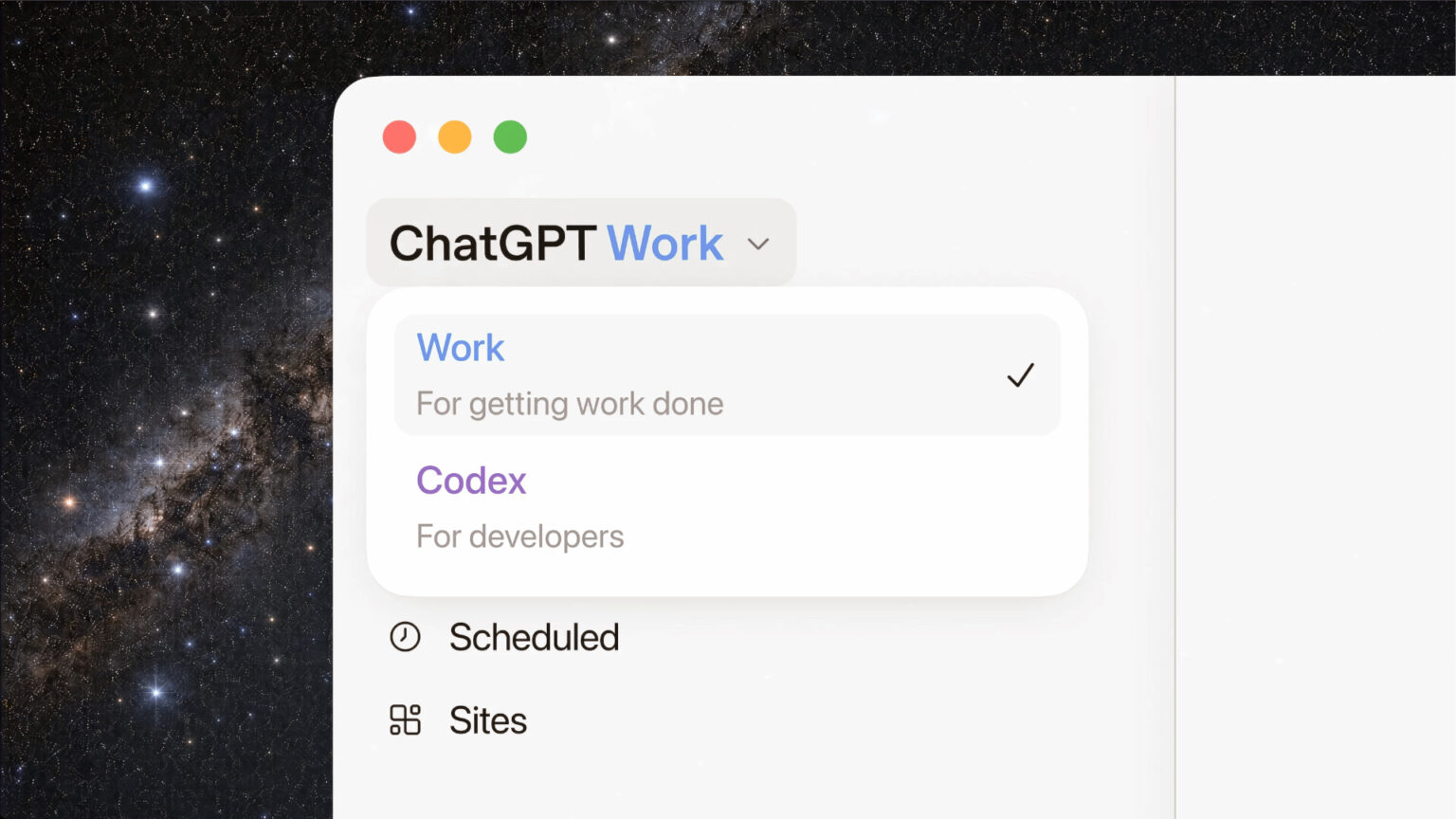
OpenAI wants ChatGPT to be more than just a place to ask questions. The new ChatGPT Work is designed to autonomously gather information from corporate applications, analyse files and turn them into finished documents, presentations, spreadsheets and web pages.
The service combines the ChatGPT interface with Codex technology, which has so far been associated mainly with programming. The agent can break down a complex task into stages, work on it for several hours and use, amongst other things, Slack, Microsoft Teams, Google Drive, SharePoint, email, calendars and CRM systems. The user will still decide which data the tool can access and which actions will require approval.
The agent’s operations are powered by the new GPT-5.6 family, available in the Sol, Terra and Luna variants. OpenAI positions them not only according to their capabilities but also according to their cost of operation. The smallest model is intended for cheaper, repetitive tasks, whilst Sol will handle the most complex processes. According to OpenAI, the models are designed to offer higher performance with lower token consumption, although these are, for the time being, primarily test results provided by the manufacturer.
ChatGPT Work is a direct response to Anthropic’s Claude Cowork, which is also capable of independently preparing analyses, spreadsheets and presentations, as well as carrying out several stages of work in parallel. The competition is therefore shifting from the quality of chatbots’ responses to the cost of executing the entire business process.
The service is being rolled out first to Pro, Enterprise and Edu users, followed by Plus and Business plans. The new application, which combines ChatGPT, Work and Codex, is also available to free accounts.