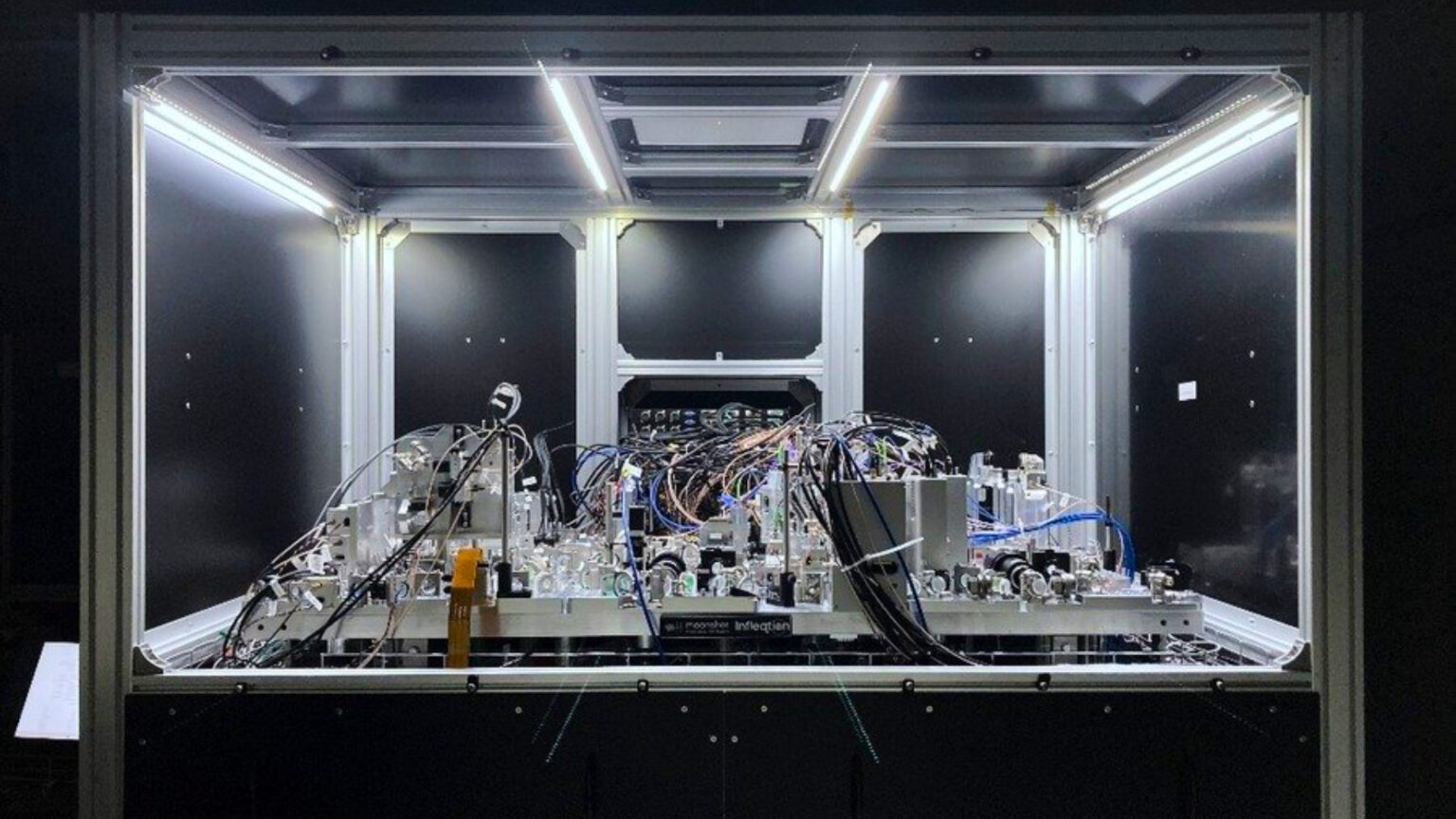
Japan has launched Shunkai, the country’s first full-scale quantum system using neutral atoms, opting for an architecture that could simplify the scaling of quantum computers and reduce infrastructure requirements.
The system was developed at the Institute for Molecular Science in Aichi Prefecture under the leadership of Professor Kenji Ohmori. Hitachi is responsible for the software layer, whilst the US firm Infleqtion supplied the QPU unit. Initially, Shunkai is set to utilise around 50 qubits, rising to around 500.
Neutral atoms are trapped using precisely controlled laser beams. Unlike systems based on superconducting qubits, the system does not require a cryogenic cooler operating at temperatures close to absolute zero. This potentially simplifies the infrastructure and may make it easier to increase the number of qubits.
For the time being, however, it is not a competitor to classical supercomputers in everyday computations. Shunkai is primarily intended for developing applications and testing error correction. By March 2031, the team aims to reach 10,000 physical qubits and a fault-tolerant system, which will also be available to external users. Integration with the existing IMS supercomputing infrastructure and the development of a hybrid quantum-GPU centre are also planned.
The project forms part of a much broader strategy for Japan. The government has set aside around 100 billion yen to accelerate the development of next-generation quantum computers. Shunkai is therefore not so much an attempt to immediately replace classical machines as an investment in one of the architectures that may determine the future balance of power in the high-performance computing market.
Computers based on neutral atoms could speed up work on quantum systems that do not require extensive cryogenic infrastructure. The atoms themselves still need to be cooled using lasers; however, doing away with large cooling systems could reduce the footprint, energy consumption and complexity of the installation. In the long term, this would be particularly significant for HPC centres and industrial applications, where easier integration with existing infrastructure may be just as important as the performance of the qubits themselves.