We all marvel at the possibilities of generative artificial intelligence, analysing its impact on the labour market or data security. However, we look less often at the bill this progress is footing for the hardware industry. This is not about subscriptions to language models, but about drastic changes to the physical supply chain. As OpenAI and Microsoft talk about a $500 billion investment, the component market is holding its breath. Giant data centres are becoming a ‘black hole’ absorbing the world’s silicon resources, and we – as an industry and as consumers – must prepare for the painful consequences of this.
For months, analysts and distributors had been warning of rising memory prices. However, reality proved to be more brutal than forecasts. The increases have been faster and steeper, and this is only the beginning of a trend that will define the IT market for years to come. We are dealing with the classic effect of the cannibalisation of the consumer market by the Enterprise market, driven by the insatiable appetite for artificial intelligence.
The ‘Stargate’ effect – the scale that changes everything
To understand why RAM or SSD prices are skyrocketing, one needs to look at the scale of investment in AI infrastructure. The ‘Stargate’ project, led by OpenAI, is emblematic of this transformation. This is not just another server room. It is a half-trillion-dollar venture to provide computing power for future generations of AI models .
The numbers behind this project are downright abstract for the average hardware supplier. We are talking about contracts with giants such as Samsung and SK Hynix, which amount to deliveries of 900,000 silicon wafers per month.
What does this mean in practice? It is estimated that the completion of just this one contract could reduce the global supply of DRAM by 40%. If one project consumes almost half of global production, that leaves a much smaller slice of the pie for the rest of the market – from smartphone manufacturers to the automotive industry to the PC market. The fight for resources becomes fierce, and in economics, scarcity always means one thing: an increase in price.
HBM is the new gold (and the nail in the coffin of cheap DDR5)
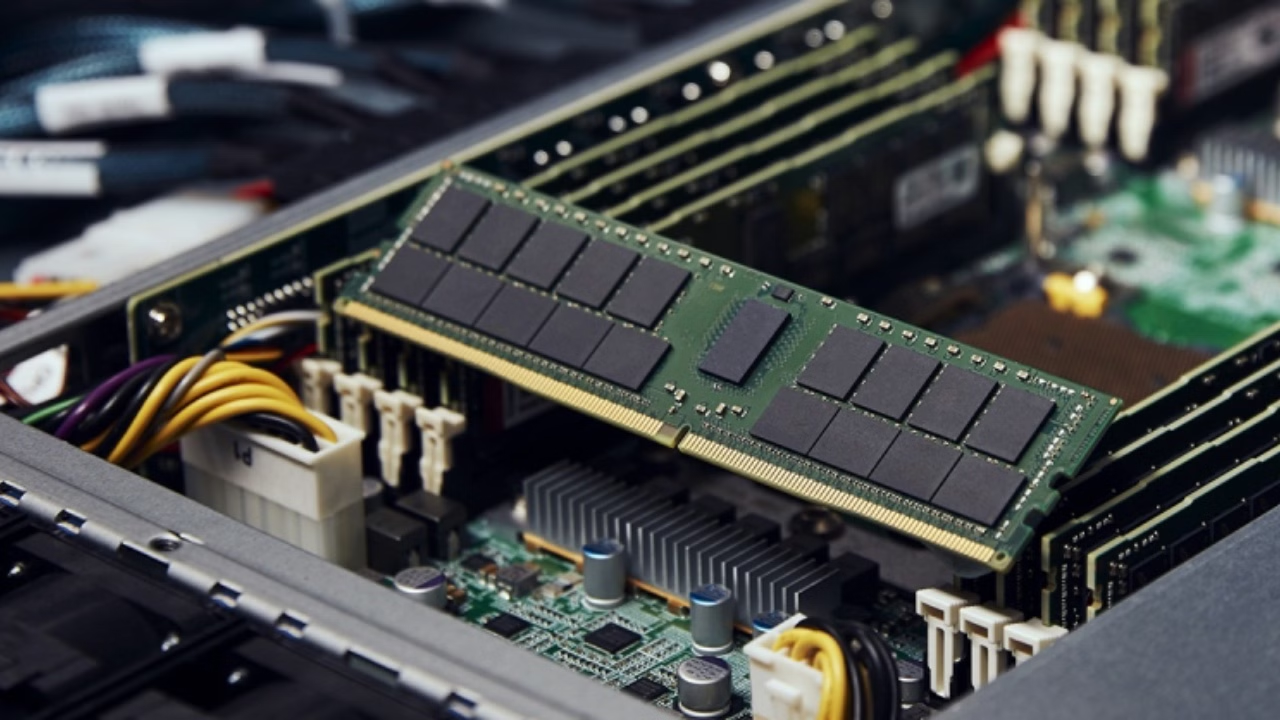
The situation is exacerbated by the fact that the memory manufacturers – the so-called Big Three (Samsung, SK Hynix, Micron) – are acting rationally. Production lines are not made of rubber and capacity is finite. Faced with the gigantic demand for HBM (High Bandwidth Memory) server memory and RDIMM modules, which are essential for AI training and offer much higher margins, manufacturers are massively shifting their factories.
The production of standard DDR5 modules, used in laptops and desktops, is receding into the background. It is a less profitable segment and is now treated as secondary. The effects are already visible in the financial reports. Micron, one of the key players, has already announced that it has sold off its HBM memory production capacity until 2026.
For the partner channel and end customers, this sends a clear signal: there will be less stock. DRAM contract prices have recently increased by 171%. By comparison, this is a jump higher than that of many investment assets, including gold, considered a safe haven in uncertain times. Memory has become a luxury commodity.
Domino effect – it’s not just PCs that are getting hit
It is a mistake to think that the problem only affects those assembling new PCs. Memory is the ‘bloodstream’ of the entire technology ecosystem. The same silicon wafers and the same factories are needed to produce NAND Flash memory (SSDs, memory cards), VRAM for graphics cards or components for consoles.
- GPU market: here the situation is twinned. While sales of consumer graphics cards remain at a relatively low level, the data centre accelerator segment is recording growth rates of 145%. NVIDIA and other manufacturers prioritise the hyperscalers (customers like Google, Meta, Microsoft) because that’s where the money is. The consumer market gets the ‘leftovers’ from the Lord’s table.
- Consoles and Gaming: Analysts are predicting that the Steam Machine will cost significantly more than originally expected. What’s more, Microsoft is considering raising the price of Xbox consoles. The reason? Rising component costs, which can no longer be taken “at face value”.
Landscape after the battle – forget cheap shopping
Is there a chance of rapid improvement? Unfortunately, the indicators do not point to it. Artificial intelligence, by its very nature, learns and improves continuously. This means it is an insatiable technology – its resource requirements (energy, water for cooling and silicon) will grow exponentially rather than linearly.
It will take the industry years to adapt global supply chains to such a sudden jump in demand. Building new factories is a lengthy and expensive process. Therefore, a scenario in which prices return to normal in 2026 seems optimistic, not to say naive.
If consumers or businesses are planning their hardware purchases, hoping for ‘big discounts’ during Black Friday in 2025, they may be sorely disappointed. Base prices for products are likely to be so high that even promotional discounts will not bring them down to the levels we remember before the AI boom era.
We are at a turning point. “AI tax” has become a reality that we need to factor into IT budgets. For resellers, integrators and purchasing departments, the conclusion from the market analysis is one: the days of cheap hardware are over.
Postponing the upgrade of infrastructure or the purchase of a fleet of laptops in anticipation of price drops is currently a highly risky strategy. The availability of components for the consumer segment is threatened by the prioritisation of AI giants. In this arms race, the average computer user unfortunately stands on the losing end, with his or her wallet becoming an unwitting sponsor of the technological revolution.