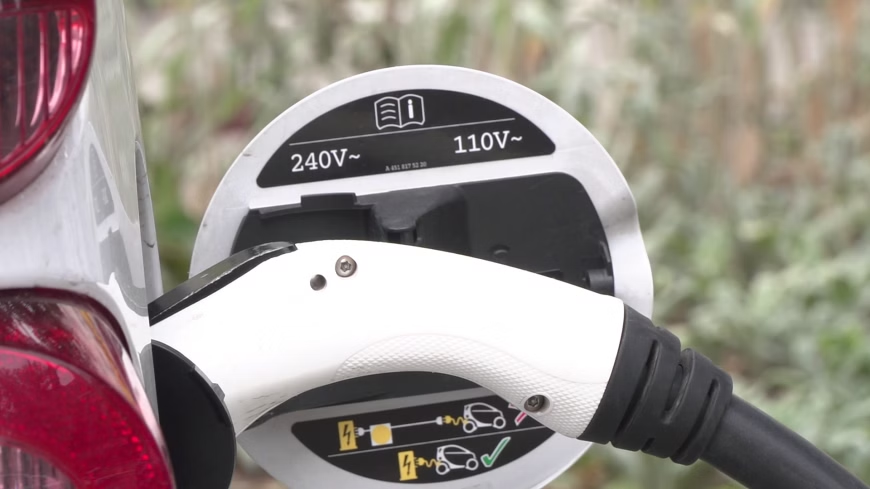
The development of charging infrastructure in the European Union is outpacing the growth in the number of electric cars. According to an analysis by Transport & Environment, all Member States except Malta already meet the EU’s requirements for publicly available charging capacity.
By the end of 2025, drivers had access to 1.1 million public charging points. This is five times more than in 2020. Data from the end of March 2026 shows that the total infrastructure in the EU exceeds the minimum target set by the AFIR Regulation by 180 per cent.
EU regulations do not merely specify the required number of chargers. Member States must ensure at least 1.3 kW of publicly available charging capacity for every registered fully electric car and 0.8 kW for every plug-in hybrid. The AFIR Regulation has been in force since 13 April 2024 and also covers rules on payment, price information and infrastructure availability.
The findings challenge the argument that the main barrier to the development of electromobility is an insufficient number of public chargers. However, this does not mean that the infrastructure problem has been completely resolved. The total capacity may be sufficient on a national scale, but it does not guarantee an even distribution of charging points or their reliability.
The greatest shortfall concerns ultra-fast chargers along major routes. In June 2026, 79 per cent of the TEN-T core road network met the requirement for stations with a capacity of at least 150 kW, spaced every 60 km. Shortfalls are primarily found in the eastern part of the EU and in Spain, although it is precisely there that networks are currently expanding most rapidly.
The data therefore show that Europe’s infrastructure is prepared for a further increase in the number of electric cars. The next challenge will be not so much the number of chargers as their location, accessibility, ease of use and price transparency.